
ESS Battery Procurement Checklist for New Distributors and Installers

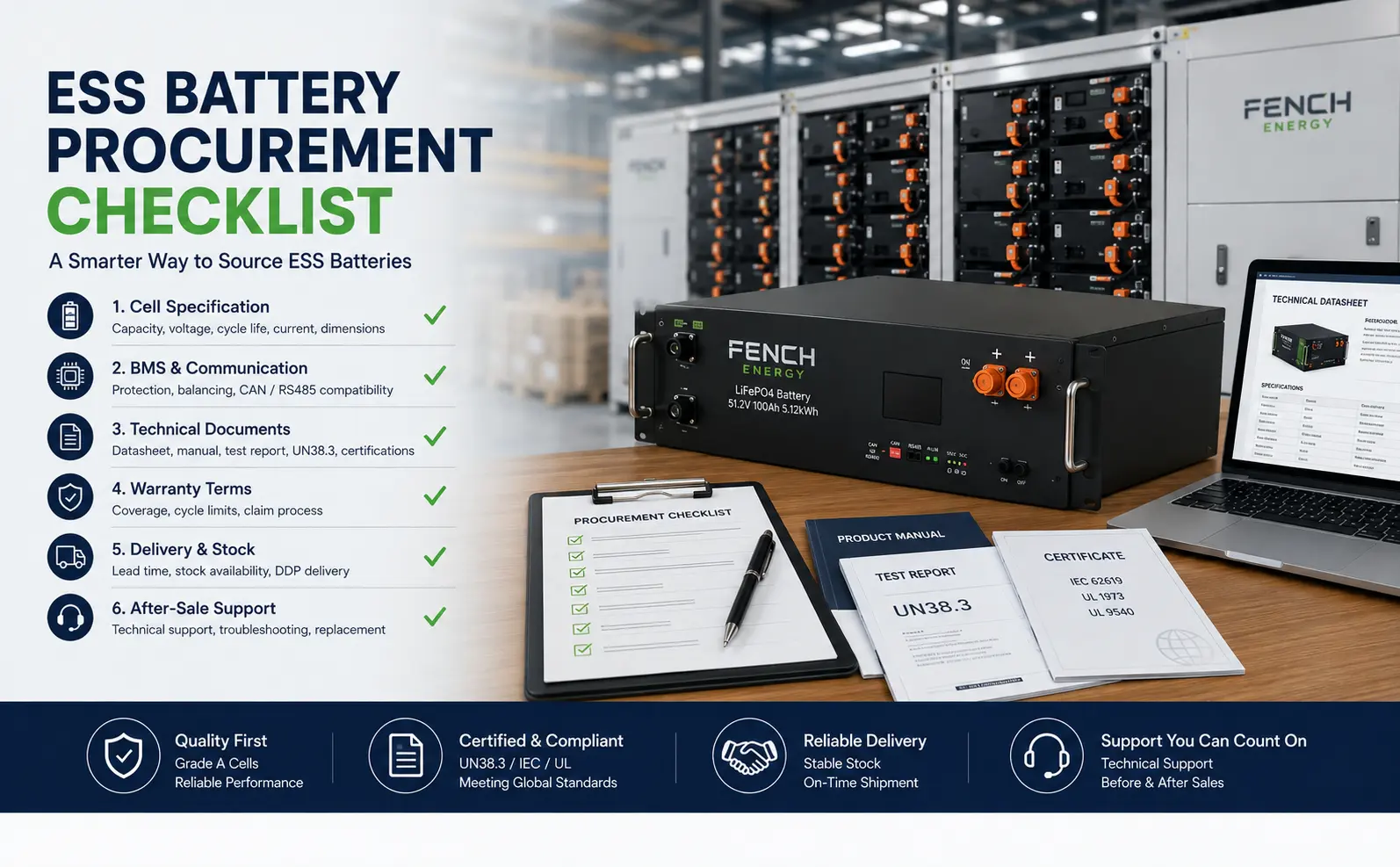
ESS battery procurement checklistIf you are new to the ESS market, the first battery order matters more than many people think. A good purchase can help you build confidence with customers. A bad one can lead to support issues, returns, and lost time.
That is why a clear ESS battery procurement checklist is useful for new distributors and installers. It helps you compare suppliers more fairly and avoid the common mistakes that often happen when buyers focus only on price.
This guide is a practical ESS battery buying guide for battery distributors, system integrators, and ESS buyers who want to make a better decision before placing an order.
1. Start with the cell, not just the price
Before you look at the final quote, check the battery cell specification.
Ask for:
- nominal voltage
- capacity
- cycle life
- discharge current
- cell dimensions
- test conditions in the datasheet
A battery may look similar from the outside, but the cell inside tells you much more about performance and long-term value. For ESS projects, that matters.
If the supplier cannot clearly explain the cell specification, it is usually a sign to slow down and ask more questions.
2. Check the BMS and communication method
For many ESS systems, the BMS is just as important as the cell itself. It protects the battery and helps the system work properly.
Before buying, check:
- overcharge protection
- over-discharge protection
- overcurrent protection
- temperature protection
- cell balancing
- supported communication protocol
For home storage and ESS applications, many buyers need CAN or RS485 communication. If your inverter and battery cannot communicate correctly, the system may still power on, but it may not work as expected.
If you are a battery distributor or system integrator, always confirm battery-inverter compatibility before confirming the order.
3. Ask for technical documents before you ask for the price
A serious supplier should provide clear technical documents, not just a quote.
At minimum, ask for:
- product datasheet
- specification sheet
- installation manual
- test report if available
- transport documents where relevant
For shipping and compliance, documents such as UN38.3 are often important. Depending on the market and application, IEC 62619, UL 1973, or UL 9540 may also be relevant.
A supplier that can provide proper technical documents is usually easier to work with during project planning and after-sales support.
4. Review the warranty terms carefully
Warranty is not just a sales line. It tells you how the supplier stands behind the product.
Before buying, ask:
- How long is the warranty?
- What is covered?
- What is not covered?
- Are there cycle limits or usage conditions?
- How is a claim handled?
For new distributors, warranty terms matter because they affect customer trust and future support costs. A product with a slightly higher price but clearer warranty terms may be the safer option.
5. Check delivery time and stock position
Delivery is one of the most overlooked parts of battery buying.
A low price is not helpful if the lead time is too long or unstable. New distributors and installers often need:
- sample units quickly
- predictable lead times
- clear packing details
- support for shipment and delivery
If the supplier offers DDP delivery or local stock, that can simplify the first few orders. For a new ESS buyer, a reliable delivery schedule is often more valuable than a small price difference.
6. Make sure support is available after the sale
A battery project does not end at shipment. You may still need help with installation questions, BMS settings, communication setup, or troubleshooting.
Before buying, ask whether the supplier can support:
- installation questions
- communication settings
- product replacement
- technical follow-up
- basic troubleshooting
This is especially important for new installers and system integrators. Good support can save time and reduce customer complaints later.
Quick ESS battery procurement checklist
Before you place an order, ask yourself these questions:
- Do I have the full battery datasheet?
- Is the cell specification clear?
- Does the BMS support my inverter?
- Is the communication protocol confirmed?
- Are the compliance documents available?
- Are the warranty terms clear?
- Is the delivery time realistic?
- Will the supplier support me after the sale?
If the answer to most of these is yes, you are in a much better position to buy.
Common mistakes new buyers make
New distributors and installers often make the same mistakes:
- choosing by price only
- ignoring BMS communication
- skipping the datasheet review
- not asking about warranty terms
- assuming all ESS batteries work with all inverters
- focusing on the product image instead of the technical details
These mistakes are easy to avoid if you use a simple procurement checklist before buying.
Final thoughts
A good ESS battery procurement checklist is not about making the buying process complicated. It is about making it safer and more predictable.
For new distributors, installers, and ESS buyers, the key is to check the cell, BMS, communication, compliance documents, warranty, delivery, and support before placing an order.
If you do that, your first purchase is more likely to become a stable long-term supply choice instead of a costly lesson.
Suggested EEAT sources
To strengthen trust, reference:
- manufacturer datasheets
- installation manuals
- BMS technical documents
- UN38.3 transport documents
- IEC 62619 / UL 1973 / UL 9540 where applicable
How to Evaluate a LiFePO4 Battery Supplier: A B2B Buyer’s Checklist
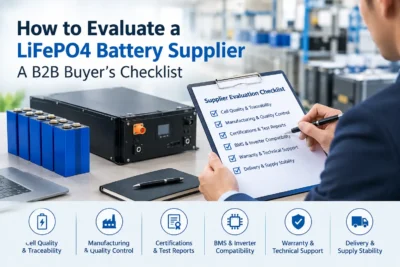
How to evaluate a LiFePO4 battery supplier is an important question for distributors, installers, and ESS buyers. Price matters, but
BMS Communication Protocol: Battery-Inverter Compatibility Guide
When buying a battery for an energy storage system (ESS), voltage and capacity are not enough. You also need to
CAN vs RS485 Battery Communication: What’s the Difference?
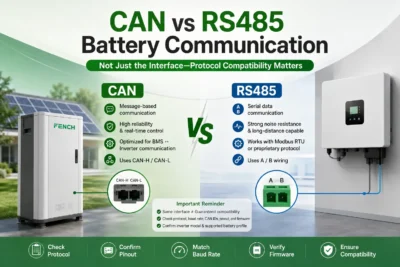
When connecting a battery to a hybrid inverter, communication is just as important as voltage and capacity. A battery may
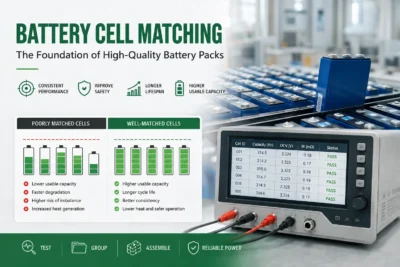
Battery Cell Matching: Why It Matters for Battery Pack Manufacturers
For battery pack manufacturers, battery cell matching is an important step before pack assembly. Cells with the same model and
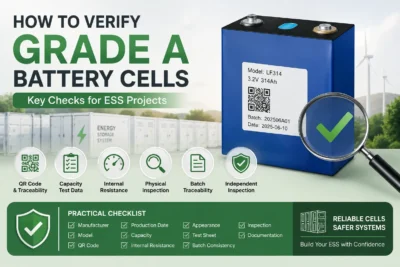
How to Verify Grade A Battery Cells for ESS Projects
When buying battery cells for an energy storage system, the label “Grade A” should not be the only thing you
ESS Battery Procurement Checklist for New Distributors and Installers
ESS battery procurement checklistIf you are new to the ESS market, the first battery order matters more than many people