
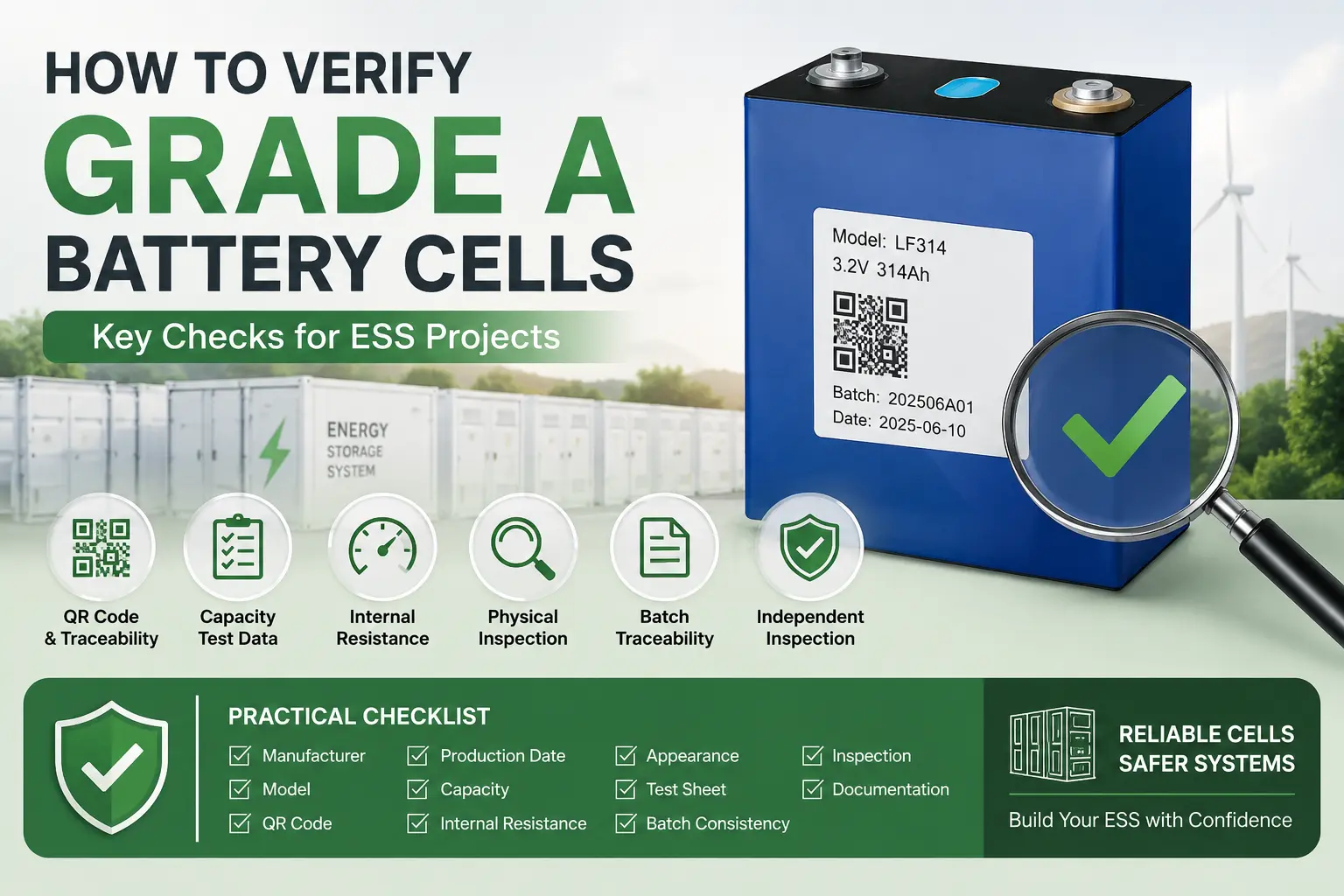
How to Verify Grade A Battery Cells for ESS Projects

When buying battery cells for an energy storage system, the label “Grade A” should not be the only thing you look at.
For ESS projects, cell consistency, traceability and test data are just as important as the quoted capacity and price. Before placing a larger order, buyers should have a clear process to verify Grade A battery cells and confirm that the cells supplied match the agreed specification.
Here are the main checks worth making.
What Does Grade A Actually Mean?
“Grade A” generally indicates that a cell meets the manufacturer’s specified quality and performance requirements.
However, Grade A is not a universal certification or independently defined quality standard. Different manufacturers may apply different grading and inspection criteria.
That is why it is better to look at the evidence behind the grade rather than relying on the term itself.
For an ESS project, ask the supplier for the exact cell manufacturer, model, production batch and relevant test data.
1. Check the QR Code and Cell Markings
Start with the cells themselves.
Depending on the manufacturer, you may find a QR code, serial number, production date, batch number or model information on the cell.
The information should be consistent with the supplier’s documentation.
A QR code by itself does not prove that a cell is Grade A. Its main value is traceability. It can help identify the production batch and provide a reference for checking the accompanying documentation.
If the supplier cannot clearly explain where the cells came from or how the batch can be traced, this is worth discussing before the order is confirmed.
2. Ask for Capacity Test Data
For ESS applications, capacity is one of the key parameters to check.
If you are purchasing a 3.2V 314Ah LiFePO4 cell, for example, don’t stop at the “314Ah” figure on the quotation. Ask how that capacity was measured.
Useful information includes:
- Rated capacity
- Measured capacity
- Test temperature
- Charge and discharge current
- Cut-off voltage
- Test date
- Production batch
Test conditions matter. A capacity figure without the test method and conditions gives you limited information.
For larger orders, it is also worth confirming that the test data relates to the production batch being supplied, rather than only to a sample shown during the quotation stage.
3. Compare Internal Resistance
Internal resistance is another useful parameter when you verify Grade A battery cells.
Cells from the same batch should generally show reasonably consistent measurements when tested under the same conditions.
Large variations can affect the behaviour of cells when they are connected in a battery pack, including current distribution and heat generation.
When reviewing internal resistance data, ask about:
- Measurement method
- Test temperature
- Test equipment
- Sampling method
- Variation between cells
There is no single resistance value that proves a cell is Grade A. The important point is that the measurement method is clear and the cells are reasonably consistent.
4. Inspect the Physical Condition
A basic visual inspection should not be overlooked.
Before accepting a shipment, check for:
- Dents or deformation
- Swelling
- Corrosion
- Damaged terminals
- Scratches or contamination
- Unusual or inconsistent markings
The cells should arrive in the condition agreed with the supplier and be properly packaged for transport.
For a small order, a simple inspection may be sufficient. For a larger ESS project, it is sensible to agree on an inspection and sampling procedure before production starts.
5. Check Batch Traceability
For commercial energy storage projects, traceability becomes particularly important.
Ideally, the supplier should be able to link:
Cell → Production Batch → Test Data → Shipment
Ask the supplier to confirm:
- Original cell manufacturer
- Exact cell model
- Production date
- Batch number
- Capacity test data
- Internal resistance data
- Relevant test documentation
This information can be useful not only before delivery, but also later if a quality issue needs to be investigated.
Good documentation makes the conversation between buyer and supplier much easier.
6. Consider Independent Inspection
For larger or higher-value ESS orders, an independent pre-shipment inspection can be worthwhile.
Depending on the project, an inspection company may check:
- Quantity
- Cell model
- QR codes or serial numbers
- Appearance
- Voltage
- Internal resistance
- Sample capacity
- Packaging
- Documentation
The exact inspection scope should be agreed in advance. There is little value in discovering after production that the buyer and supplier had different expectations about what would be checked.
A Practical Grade A Cell Checklist
Before accepting an ESS battery cell order, check the following:
| Check | What to Confirm |
|---|---|
| Manufacturer | Original cell manufacturer |
| Model | Exact cell model |
| QR code | Traceability information |
| Production date | Batch and manufacturing information |
| Capacity | Rated and measured capacity |
| Internal resistance | Test method and consistency |
| Appearance | No visible damage or deformation |
| Test sheet | Test conditions and results |
| Batch | Documentation matches supplied cells |
| Inspection | Pre-shipment inspection if required |
Questions to Ask Before Ordering
If you are sourcing cells for an ESS project, a few straightforward questions can save a lot of time later:
- Who is the original cell manufacturer?
- What is the exact cell model?
- When was the batch produced?
- Can the QR code or serial number be traced?
- Can you provide capacity and internal resistance data?
- Under what conditions were the cells tested?
- Does the test data relate to the batch being supplied?
- Can the order be inspected before shipment?
The supplier’s willingness to provide clear answers is useful information in itself.
Final Thoughts
To verify Grade A battery cells, don’t rely on the grade printed on a quotation.
Look at the manufacturer, QR code, production batch, capacity data, internal resistance, physical condition and supporting test documents. For larger ESS projects, independent inspection can provide an additional level of confidence.
The most effective approach is to agree on the specifications and inspection requirements before placing the purchase order. That gives both sides a clear reference for what is being supplied and what will be accepted.
How to Evaluate a LiFePO4 Battery Supplier: A B2B Buyer’s Checklist
How to evaluate a LiFePO4 battery supplier is an important question for distributors, installers, and ESS buyers. Price matters, but
BMS Communication Protocol: Battery-Inverter Compatibility Guide
When buying a battery for an energy storage system (ESS), voltage and capacity are not enough. You also need to
CAN vs RS485 Battery Communication: What’s the Difference?
When connecting a battery to a hybrid inverter, communication is just as important as voltage and capacity. A battery may
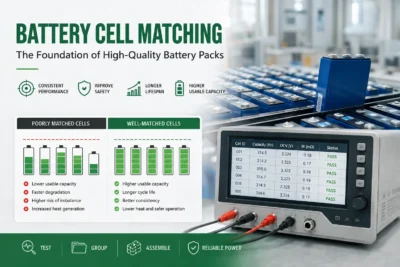
Battery Cell Matching: Why It Matters for Battery Pack Manufacturers
For battery pack manufacturers, battery cell matching is an important step before pack assembly. Cells with the same model and
How to Verify Grade A Battery Cells for ESS Projects
When buying battery cells for an energy storage system, the label “Grade A” should not be the only thing you
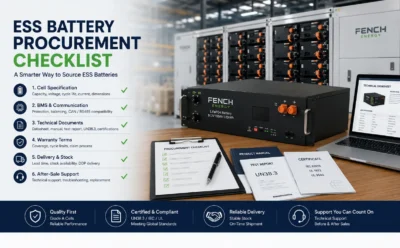
ESS Battery Procurement Checklist for New Distributors and Installers
ESS battery procurement checklistIf you are new to the ESS market, the first battery order matters more than many people