
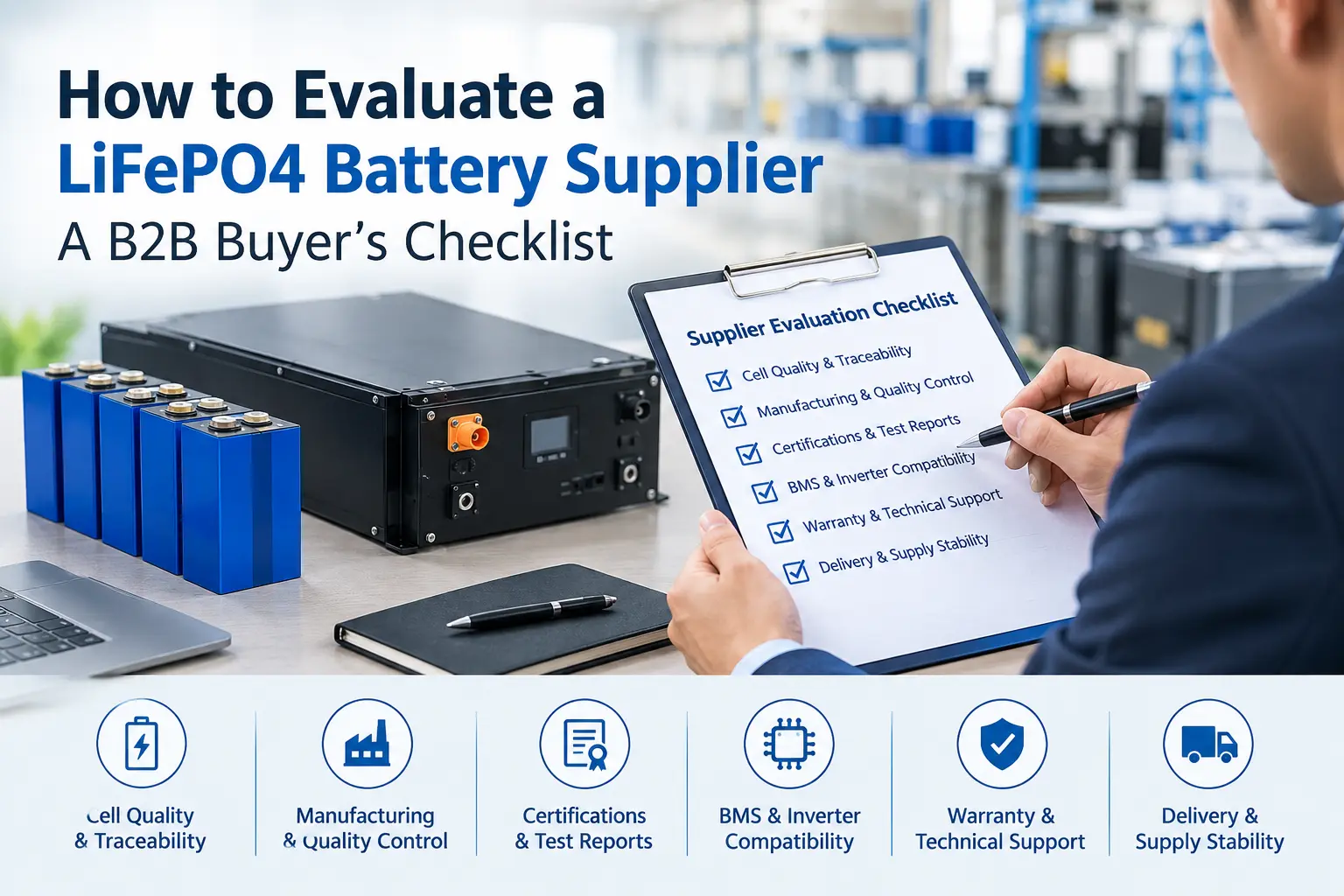
How to Evaluate a LiFePO4 Battery Supplier: A B2B Buyer’s Checklist

How to evaluate a LiFePO4 battery supplier is an important question for distributors, installers, and ESS buyers. Price matters, but it should not be the only factor.
A low quotation means little if the cells are inconsistent, the BMS is incompatible, certifications are unclear, or after-sales support is difficult to obtain.
Before placing a larger order, evaluate the supplier across cell quality, manufacturing, certifications, BMS compatibility, warranty, and delivery capability.
1. Check Cell Quality and Traceability
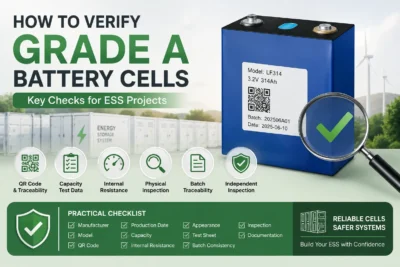
The battery cell is the foundation of a LiFePO4 battery pack.
Ask the supplier:
- What cell manufacturer and model are used?
- Are the cells Grade A?
- How are cells matched?
- Is internal resistance tested?
- Can the production batch be traced?
Do not rely on the words “Grade A” alone. A reliable supplier should be able to explain its cell selection, inspection, matching, and traceability process.
For ESS applications, consistent cells help support stable performance and reduce the risk of cell imbalance.
Internal link opportunity: Link “Grade A LiFePO4 cells” to your existing article about verifying Grade A cells.
2. Evaluate Manufacturing and Quality Control
A company selling batteries is not necessarily the actual manufacturer.
Find out where the batteries are assembled and how quality is controlled.
Key areas include:
- Cell incoming inspection
- Cell matching
- Battery assembly
- BMS installation
- Electrical safety checks
- End-of-line testing
- Serial-number traceability
For larger projects, ask for factory information, production records, or an audit where appropriate.
The important question is whether the supplier can produce consistent quality from batch to batch.
3. Verify Certifications and Test Reports
Certification requirements depend on the battery model, application, and target market.
Depending on the product, buyers may need documents such as:
Do not rely only on certification logos shown on a website. Ask for the actual documents and check the product model, certificate holder, manufacturer, product scope, and issuing organization.
A certificate for one battery model should not automatically be assumed to cover every product from the same supplier.
External link opportunity: Link “IEC 62619” to the official IEC website and “UN 38.3” to an authoritative transport or regulatory resource.
4. Check BMS and Inverter Compatibility
Correct voltage and capacity do not guarantee inverter compatibility.
The BMS should provide protection against:
- Over-voltage
- Under-voltage
- Over-current
- Short circuit
- High and low temperature
Also check:
- CAN or RS485 communication
- Communication protocol
- Communication parameters
- Supported inverter models
- Compatibility testing
If possible, choose a supplier that can provide evidence of actual battery-inverter testing.
For ESS projects, BMS communication compatibility can be just as important as battery voltage and capacity.
Internal link opportunity: Link “CAN or RS485 communication” to your existing CAN vs RS485 article.
5. Review Warranty and Technical Support
A long warranty is useful only when its terms are clear.
Before ordering, check:
- Warranty period
- Capacity-retention conditions
- Operating requirements
- Warranty exclusions
- RMA procedure
- Replacement policy
- Technical support
You can also test the supplier before purchasing by asking detailed technical questions.
A supplier that gives clear technical answers before the order is more likely to provide useful support after the sale.
6. Check Delivery and Supply Stability
For B2B buyers, reliability also means consistent delivery.
Compare:
- Production lead time
- Stock availability
- Minimum order quantity
- Repeat-order capacity
- Batch consistency
- Replacement availability
A lower unit price is not valuable if production delays your project or replacement batteries are difficult to obtain.
For distributors and installers, consistent specifications across repeat orders are especially important.
LiFePO4 Battery Supplier Evaluation Checklist
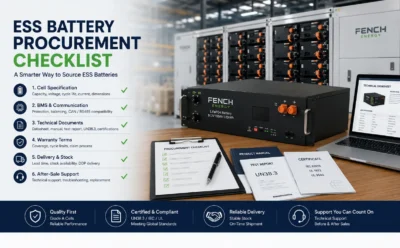
Before placing a larger order, ask for:
✓ Cell manufacturer and model
✓ Cell grade and matching information
✓ Battery datasheet
✓ BMS specifications
✓ Communication protocol information
✓ Applicable certification documents
✓ Model-specific test reports
✓ Warranty and RMA terms
✓ Production lead time
✓ Inverter compatibility information
Red Flags to Watch For
Be cautious if a supplier:
- Cannot identify the cell manufacturer or model
- Uses “Grade A” without supporting information
- Provides certification logos but no documents
- Cannot explain its BMS communication protocol
- Offers unclear warranty or RMA terms
- Changes specifications between batches without explanation
- Avoids technical questions
- Focuses heavily on price but provides little documentation
These signs do not automatically mean a supplier is unreliable, but they indicate that further verification is needed.
How Fench Power Evaluates Battery Quality
At Fench Power, battery quality is approached through cell selection, battery assembly, BMS configuration, testing, and technical support.
For B2B customers, product information should be based on model-specific specifications and verifiable technical details, rather than generic claims about battery quality.
This includes information about:
- LiFePO4 cell specifications
- Battery configuration
- BMS functions and communication
- Product testing
- Applicable certifications
- Installation requirements
- Warranty terms
For larger projects, technical requirements can be reviewed before production to confirm that the battery configuration, communication method, and application requirements are aligned.
This first-hand manufacturing and engineering approach helps B2B buyers make decisions based on evidence rather than sales claims.
Internal link opportunity: Link “Fench Power” or “LiFePO4 battery solutions” to your relevant product/company page.
Frequently Asked Questions
How do I evaluate a LiFePO4 battery supplier?
Compare cell quality, manufacturing controls, certifications, BMS compatibility, testing, warranty, delivery capability, and technical support. Price should be only one part of the decision.
What should I ask a battery supplier before ordering?
Ask for the cell manufacturer and model, datasheet, BMS specifications, communication protocol, certifications, test reports, warranty terms, lead time, and inverter compatibility information.
How can I verify Grade A LiFePO4 cells?
Ask for the cell manufacturer, model, production batch, test information, and matching process. Do not rely only on the “Grade A” label.
How do I verify battery-inverter compatibility?
Check the battery voltage and capacity, then confirm the BMS communication protocol, CAN or RS485 configuration, supported inverter models, and compatibility testing.
Final Takeaway
The best way to evaluate a LiFePO4 battery supplier is to compare evidence, quality, compatibility, and support—not price alone.
Check the cells. Verify the documents. Confirm BMS compatibility. Review the warranty. Evaluate production and delivery capability.
The lowest quotation may reduce your initial purchase cost, but a reliable supplier can help reduce the much larger risks associated with quality problems, compatibility issues, project delays, and after-sales failures.
How to Evaluate a LiFePO4 Battery Supplier: A B2B Buyer’s Checklist
How to evaluate a LiFePO4 battery supplier is an important question for distributors, installers, and ESS buyers. Price matters, but
BMS Communication Protocol: Battery-Inverter Compatibility Guide
When buying a battery for an energy storage system (ESS), voltage and capacity are not enough. You also need to
CAN vs RS485 Battery Communication: What’s the Difference?
When connecting a battery to a hybrid inverter, communication is just as important as voltage and capacity. A battery may
Battery Cell Matching: Why It Matters for Battery Pack Manufacturers
For battery pack manufacturers, battery cell matching is an important step before pack assembly. Cells with the same model and
How to Verify Grade A Battery Cells for ESS Projects
When buying battery cells for an energy storage system, the label “Grade A” should not be the only thing you
ESS Battery Procurement Checklist for New Distributors and Installers
ESS battery procurement checklistIf you are new to the ESS market, the first battery order matters more than many people