When connecting a battery to a hybrid inverter, communication is just as important as voltage and capacity. A battery may have the correct voltage and enough energy capacity, but the system can still fail to communicate if the battery BMS and inverter use different communication methods or protocols.
This is why understanding CAN vs RS485 battery communication is important for battery distributors, installers, and ESS integrators.
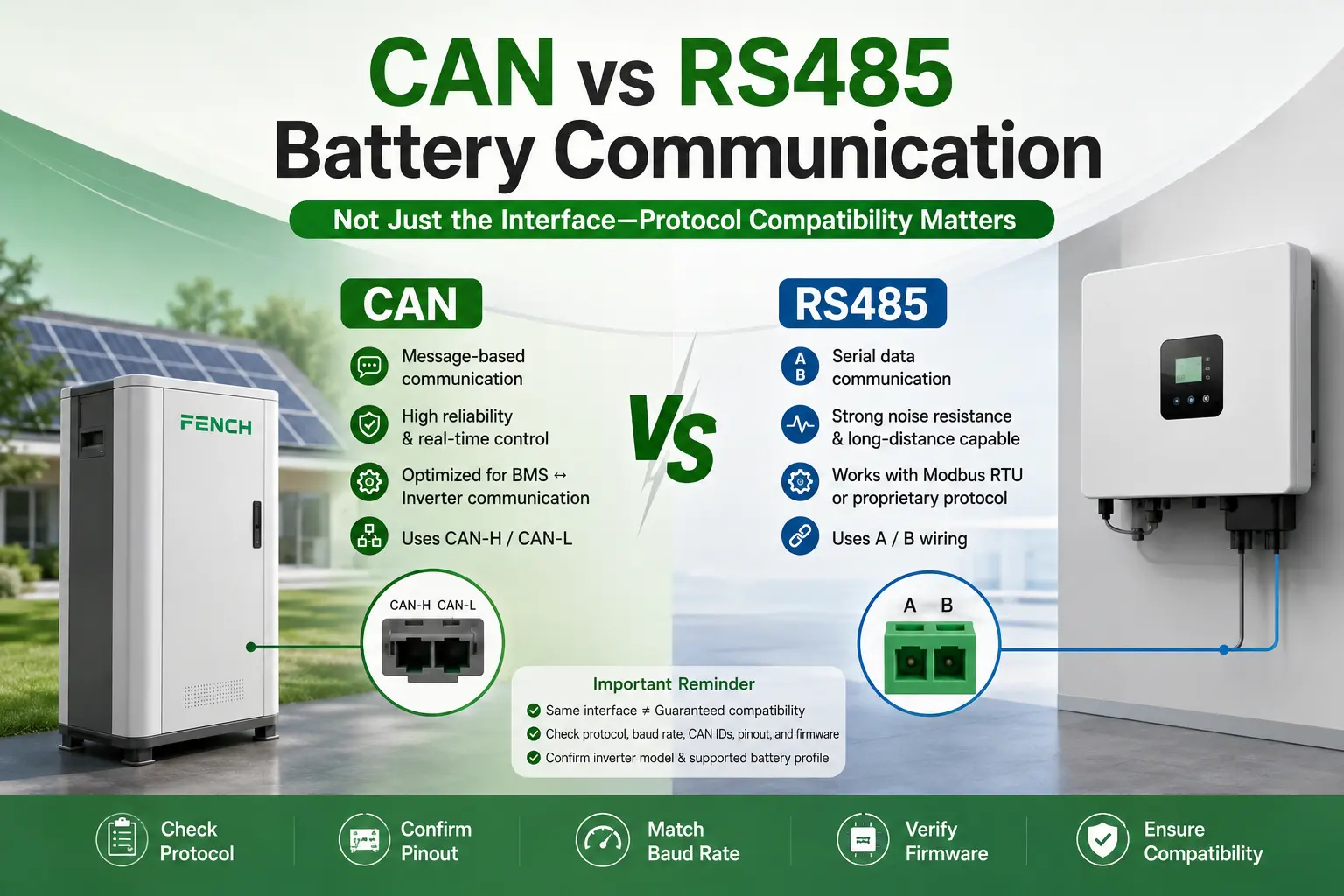
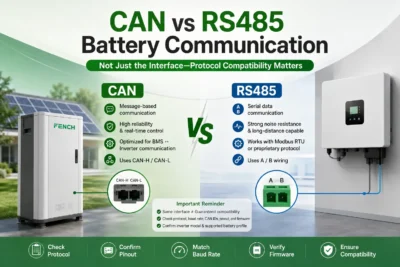
The key point is simple: CAN and RS485 are not exactly equivalent technologies. CAN defines a communication bus with its own communication rules, while RS485 mainly defines the electrical signaling used to transmit serial data. In battery systems, RS485 is commonly used together with protocols such as Modbus RTU or a manufacturer-specific protocol.
CAN vs RS485 battery communication: The Basic Difference
| Feature | CAN | RS485 |
|---|
| Main role | Communication bus and protocol framework | Electrical signaling standard |
| Common battery use | BMS-to-inverter communication | BMS monitoring and serial communication |
| Typical wiring | CAN-H / CAN-L | A / B |
| Communication method | Message-based | Serial data |
| Common higher-level protocol | CAN-based battery profiles | Modbus RTU or proprietary protocols |
| Noise resistance | High | High |
| Compatibility | Depends on CAN profile and inverter support | Depends on protocol and inverter support |
This distinction matters because simply seeing “CAN” or “RS485” on a product datasheet does not prove that two devices are compatible.
How CAN Communication Works in Battery Systems
CAN, or Controller Area Network, is widely used for communication between battery BMSs and hybrid inverters.
The BMS can send information such as:
- State of charge (SOC)
- Battery voltage and current
- Cell or battery temperature
- Maximum charge current
- Maximum discharge current
- Alarm and protection status
The inverter uses this information to adjust charging and discharging behavior.
CAN is particularly useful when the battery and inverter are designed around the same communication profile. It can provide structured, real-time battery information without requiring the inverter to independently calculate every operating limit.
However, CAN does not automatically mean compatibility.
Two devices can both support CAN but still fail to communicate if they use different baud rates, message formats, CAN IDs, or battery profiles.
How RS485 Communication Works
RS485 is a differential electrical interface designed for reliable serial communication. It is commonly used in industrial equipment because it offers good noise resistance and can support relatively long cable runs.
In battery systems, RS485 is often combined with a communication protocol such as Modbus RTU.
Depending on the BMS and inverter, RS485 may be used to transmit:
- Voltage and current data
- SOC and SOH
- Temperature
- Alarm information
- Charging and discharging limits
- Battery status
The important point is that RS485 only defines how electrical signals are transmitted. It does not define the meaning of the data itself.
For example, two devices can both use RS485 but use different communication protocols. One may use Modbus RTU while another uses a proprietary protocol. They may have the same physical interface but still be unable to understand each other’s data.
CAN vs RS485 battery communication: Which Is Better?
There is no universal winner.
The right choice depends on the battery BMS, inverter, communication protocol, and system requirements.
CAN is often preferred for battery-to-inverter communication when the inverter manufacturer provides a specific CAN battery profile. It is commonly used for exchanging structured BMS information and operating limits.
RS485 can be a practical choice when the inverter and battery support the same serial communication protocol, such as Modbus RTU. It is also widely used for monitoring and communication over longer cable distances.
For an ESS project, the better question is not:
“Is CAN better than RS485?”
The better question is:
“Does this battery BMS use a communication protocol that this inverter can understand?”
Why CAN or RS485 Does Not Guarantee Compatibility
This is one of the most common mistakes when selecting batteries.
Suppose a battery specification says:
Communication: CAN
and an inverter specification also says:
Communication: CAN
That does not necessarily mean they will work together.
Compatibility can depend on:
- Communication interface
- Baud rate
- CAN IDs or register addresses
- Data format
- Battery protocol/profile
- RS485 protocol, such as Modbus RTU
- Communication cable and pinout
- Inverter firmware
- BMS firmware
The same principle applies to RS485.
A battery and inverter can both have RS485 ports but still fail to communicate because their protocols or register maps are different.
What Should B2B Buyers Check?
Before purchasing a battery for a hybrid inverter, confirm these points with the supplier:
- Inverter model – Check the exact model, not only the brand.
- Communication interface – Confirm whether CAN, RS485, or both are supported.
- BMS protocol – Ask which communication profile or protocol the battery uses.
- Baud rate – Confirm the required communication speed.
- Pinout – Check CAN-H/CAN-L or RS485 A/B wiring.
- Firmware compatibility – Confirm whether the inverter and BMS versions are supported.
- Communication cable – Make sure the correct cable and pin configuration are supplied.
- Compatibility list – Request an official compatibility list or commissioning guide.
Final Takeaway
The difference between CAN vs RS485 battery communication is not simply that one is faster or better than the other.
CAN provides a dedicated communication bus with defined message handling, while RS485 mainly provides the electrical layer for serial communication. In battery systems, both can work well, but successful communication depends on the protocol used above the physical connection.
For hybrid inverter applications, interface compatibility is only the first step. The BMS protocol, data format, baud rate, pinout, and firmware must also match.
For B2B battery buyers, the safest approach is straightforward: confirm the inverter model, BMS protocol, communication interface, and compatibility before placing the order or shipping the battery.