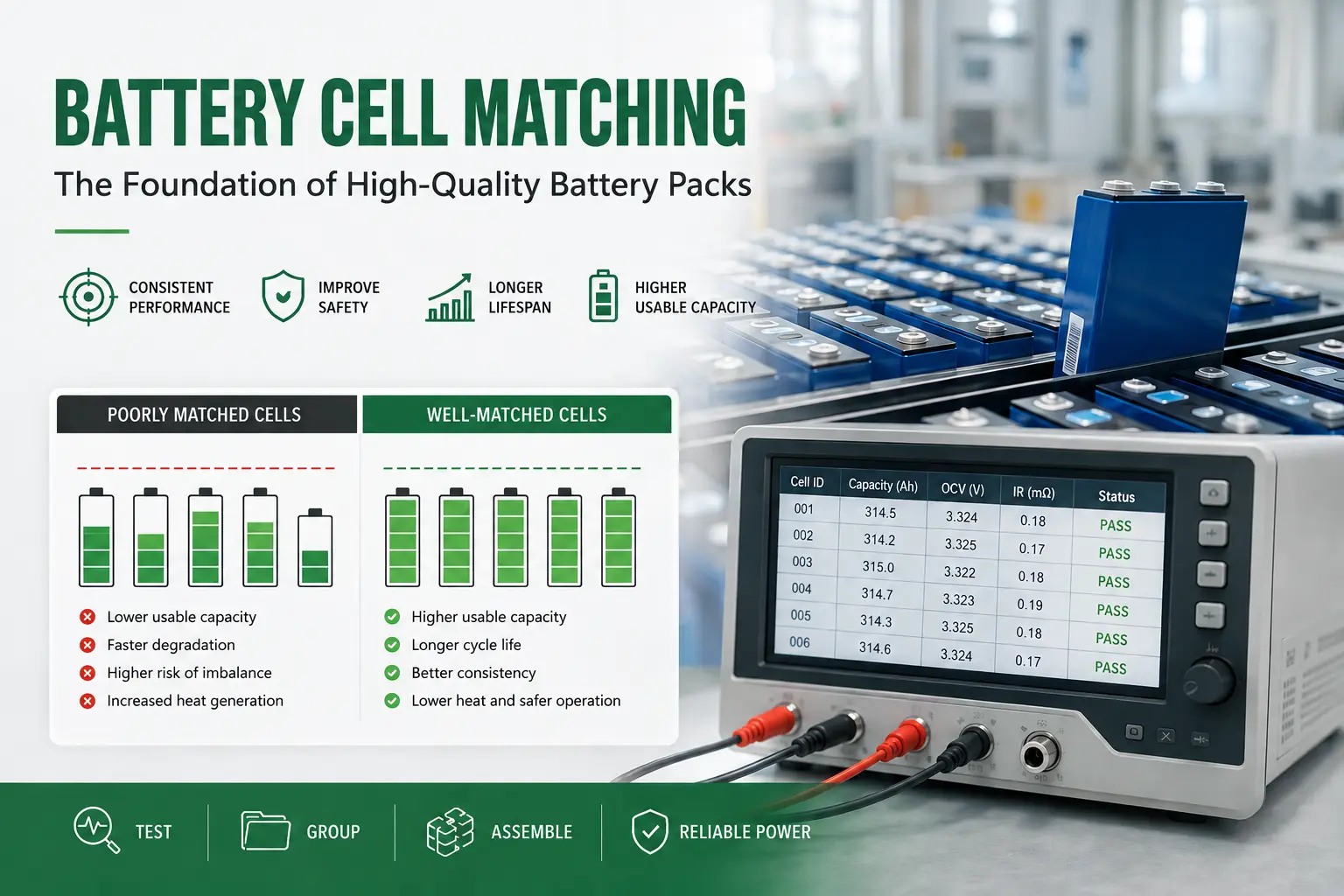
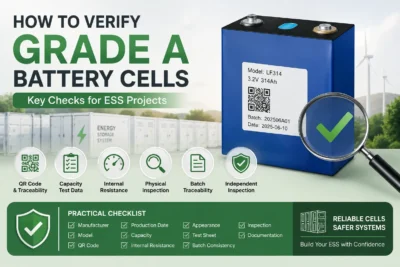
For battery pack manufacturers, battery cell matching is an important step before pack assembly. Cells with the same model and nominal capacity can still differ in actual capacity, voltage, internal resistance, and self-discharge behavior.
These differences may seem small at the cell level, but they can become significant when multiple cells are connected in series or parallel. For ESS battery production, proper cell matching helps improve pack consistency, usable capacity, thermal performance, and long-term stability.
What Is Battery Cell Matching?
Battery cell matching is the process of testing and grouping cells with similar electrical characteristics before they are assembled into a battery pack.
The main parameters normally include:
- Capacity
- Open-circuit voltage (OCV)
- Internal resistance
- Self-discharge behavior
- Production batch and traceability
The goal is not to make every cell completely identical. Instead, manufacturers group cells within an acceptable range so that no single cell becomes the weak point of the pack.
For LiFePO4 cell matching, capacity and internal resistance are particularly important because these parameters directly affect how cells behave during charge and discharge.
Why Capacity Matching Matters
Capacity matching helps ensure that cells in the same pack can store and deliver a similar amount of energy.
If one cell has significantly lower capacity, it may reach its charge or discharge limit before the other cells. In a series-connected pack, that weaker cell can limit the usable capacity of the entire battery.
This can result in:
- Reduced usable energy
- Earlier BMS protection
- More frequent balancing
- Lower pack consistency
For ESS applications that cycle every day, these differences can become more noticeable over time.
Why Internal Resistance Matching Matters
Internal resistance matching is another key part of battery cell grading.
Cells with different resistance can produce different voltage drops and heat levels under load. In parallel configurations, resistance differences can also cause uneven current sharing.
Research published in the Journal of Power Sources found that a 20% resistance difference between parallel-connected lithium-ion cells was associated with a substantial reduction in cycle life under high-rate cycling conditions.
This is why battery pack manufacturers should not select cells based on capacity alone. Resistance data should be evaluated under consistent test conditions, including temperature, state of charge, and measurement method.
Voltage Matching and OCV
Voltage matching is usually checked before pack assembly.
Cells with similar OCV are easier to group and balance. A large initial voltage difference means the BMS may need to perform more balancing after assembly.
However, voltage alone should not be used to determine whether cells are a good match. A group of cells can show similar voltage while still having differences in capacity or internal resistance.
For this reason, reliable battery cell matching normally considers several parameters together.
How to Match LiFePO4 Cells Before Pack Assembly
A practical matching process for LiFePO4 prismatic cells can follow these steps:
- Verify the cell model and chemistry
Confirm that cells have the same chemistry, nominal voltage, capacity class, and specifications. - Check production batch information
Batch consistency and traceability can help reduce variation between cells. - Measure voltage and OCV
Record cell voltage under controlled conditions. - Test capacity
Compare actual capacity using the same test procedure and conditions. - Measure internal resistance
Use the same measurement method, temperature, and SOC when comparing cells. - Group similar cells
Select cells with compatible capacity, voltage, and resistance characteristics before assembly.
This process is more reliable than choosing cells only by datasheet values or purchase price.
Can a BMS Fix Poor Cell Matching?
No. A BMS can monitor cell voltage and temperature, provide protection, and perform balancing where supported, but it cannot turn significantly different cells into identical cells.
Good cell matching should happen before battery pack assembly. The BMS should be treated as a protection and management system, not a replacement for proper cell selection and grading.
Why Cell Matching Matters for ESS Battery Production
For ESS battery manufacturers, consistent cells are important because battery packs are expected to operate for many cycles with predictable performance.
Proper battery cell matching can help:
- Improve pack consistency
- Reduce cell imbalance
- Maintain usable capacity
- Reduce uneven heating
- Support longer and more stable operation
For manufacturers using LiFePO4 prismatic cells, reviewing capacity data, resistance data, test conditions, and batch records before assembly is a practical way to improve pack quality.
FAQ
What is battery cell matching?
Battery cell matching is the process of grouping cells with similar capacity, voltage, internal resistance, and other relevant characteristics before pack assembly.
Manufacturers typically compare cell model, batch, OCV, capacity, and internal resistance under consistent testing conditions before grouping cells.
Can a BMS replace cell matching?
No. A BMS manages and protects the finished pack, but it cannot fully correct significant differences between individual cells.
Why is internal resistance matching important?
It helps reduce uneven voltage drop, current sharing, and heat generation, particularly in high-current battery pack applications.