How to Evaluate LiFePO4 Battery Quality Before Bulk Orders
Buying LiFePO4 batteries in bulk requires more than comparing price, capacity, and cycle life. For distributors, solar installers, system integrators, and energy storage companies, inconsistent battery quality can lead to higher warranty costs, installation problems, and customer complaints.
So, how do you evaluate LiFePO4 battery quality before a bulk order?
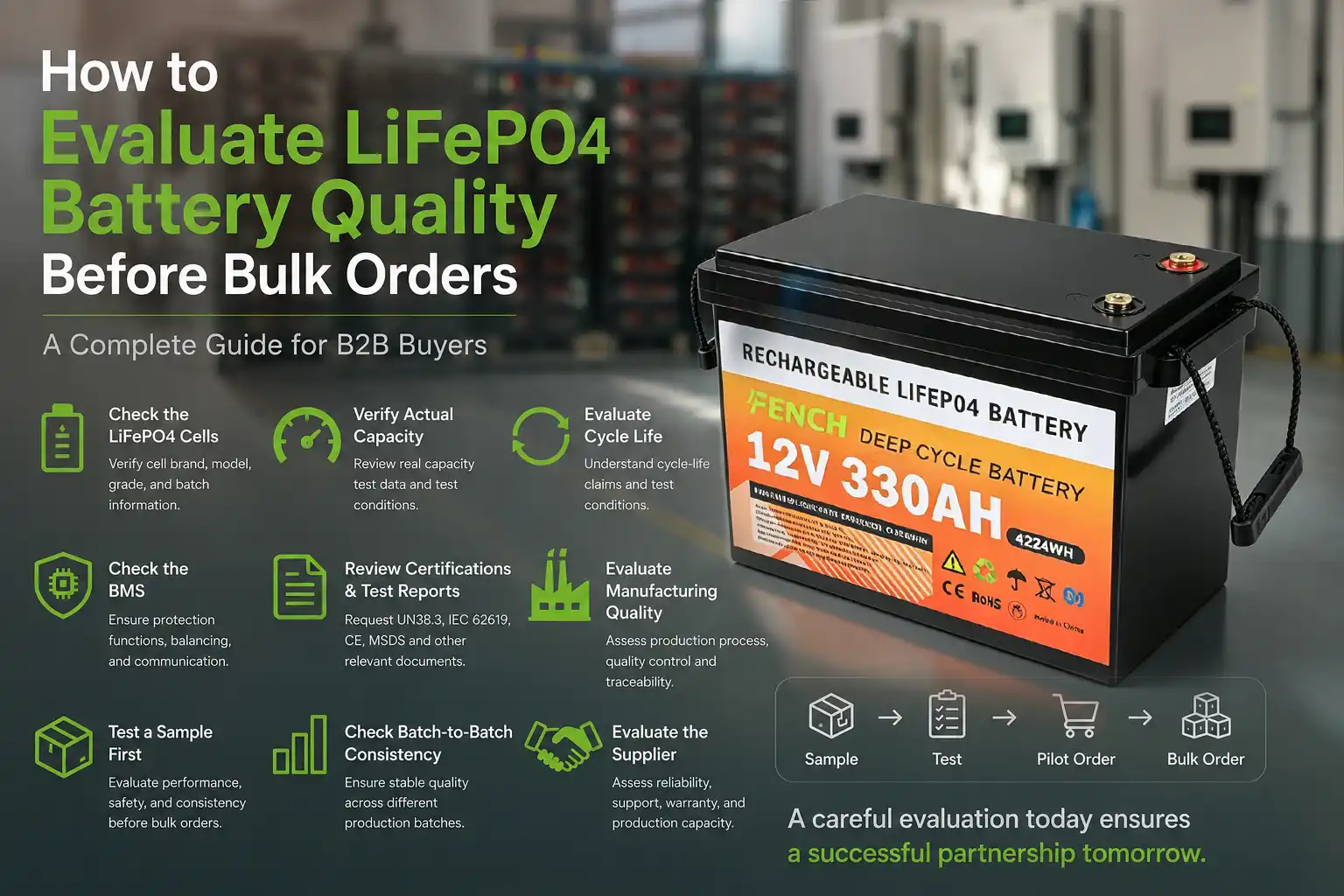
Buyers should check the battery cells, actual capacity, cycle life, BMS, certifications, manufacturing quality, and batch consistency. This guide provides a practical LiFePO4 battery quality inspection checklist to help buyers reduce procurement risks.
Why LiFePO4 Battery Quality Matters for Bulk Orders
When purchasing one battery, a quality problem may affect a single user. With a bulk order, the same problem can affect hundreds of batteries.
Common risks include:
- Lower-than-expected capacity
- Inconsistent battery performance
- Premature capacity degradation
- BMS protection problems
- Higher warranty and replacement costs
- Delays caused by quality issues
For B2B buyers, consistent quality across the entire production batch is often more important than the performance of a single sample.
1. Check the LiFePO4 Battery Cells
The battery cell is one of the most important factors when evaluating battery quality.
Before placing an order, ask the supplier for:
- Cell manufacturer and model
- Nominal capacity
- Cell chemistry
- Production date and batch
- Cell grade
- Relevant test information
If a battery is advertised as using 314Ah LiFePO4 cells, for example, the supplier should be able to provide clear information about the actual cell model and manufacturer.
How to Check LiFePO4 Battery Quality at the Cell Level
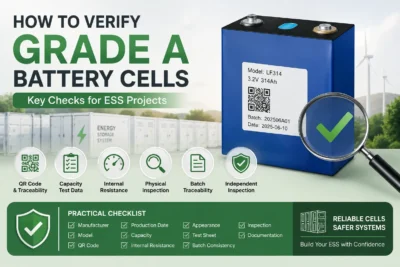
Do not rely only on a “Grade A” label. Buyers should verify the cell manufacturer, model, batch information, and supporting documentation.
For larger orders, sample testing or third-party inspection can provide additional confidence before production begins.
2. Verify Actual Battery Capacity
One of the most important steps when learning how to test LiFePO4 batteries before buying is verifying their actual capacity.
The advertised capacity should be supported by test data showing how it was measured.
When reviewing a LiFePO4 battery capacity test, check:
- Rated and measured capacity
- Charging voltage
- Discharge current
- Cut-off voltage
- Test temperature
- Testing method
For example, a 314Ah battery should have test conditions that explain how the 314Ah rating was obtained.
Different testing conditions can produce different results, so buyers should always evaluate the capacity together with the test conditions.
3. Check LiFePO4 Battery Cycle Life
Cycle life is another important specification, but a claim such as “8,000+ cycles” should not be evaluated by the number alone.
When checking LiFePO4 battery cycle life, ask about:
- Charge and discharge rate
- Depth of discharge (DoD)
- Operating temperature
- Charging voltage
- Discharge cut-off voltage
- Capacity retention at the end of testing
A cycle-life figure is meaningful only when its testing conditions are clearly defined.
Professional suppliers should be able to explain how their cycle-life data was obtained instead of simply providing a high cycle number.
4. Evaluate the LiFePO4 Battery BMS
The Battery Management System (BMS) protects the battery and monitors important operating parameters.
When evaluating LiFePO4 battery BMS quality, buyers should check whether the BMS provides:
- Overcharge protection
- Over-discharge protection
- Over-current protection
- Short-circuit protection
- Over-temperature protection
- Cell balancing
- Voltage and temperature monitoring
- Communication functions
For energy storage systems, communication compatibility with the inverter can also be important.
Therefore, do not evaluate a LiFePO4 battery only by its capacity. Cell quality and BMS performance should be considered together.
5. Review LiFePO4 Battery Certifications and Test Reports
Certifications and technical documents are particularly important for international B2B purchases.
Depending on the application and destination market, buyers may need to review:
- UN38.3 test documentation
- IEC 62619-related documentation
- CE-related documentation
- SDS/MSDS
- EMC-related documentation where applicable
- Product test reports
- Technical datasheets
However, buyers should understand what each document actually demonstrates.
For example, UN38.3 is associated with transportation testing requirements for lithium batteries, while IEC 62619 addresses safety requirements for certain secondary lithium cells and batteries used in industrial applications.
Certifications can provide important compliance and safety evidence, but they should not replace product-level quality inspection.
6. Evaluate the Manufacturer’s Quality Control
A reliable LiFePO4 battery manufacturer should have a clear quality-control process throughout production.
Ask how the supplier manages:
Incoming inspection: Are cells and components checked before production?
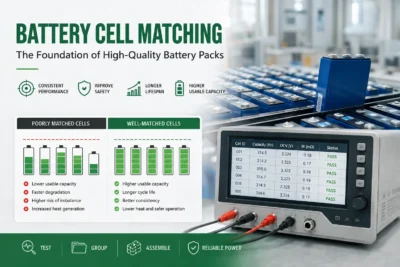
Cell matching: Are cells evaluated for relevant parameters such as voltage, capacity, and consistency?
Assembly: How are welding, wiring, insulation, and BMS installation controlled?
Testing: Are finished batteries tested before shipment?
Final inspection: Are voltage, appearance, labeling, packaging, and communication functions checked?
A structured quality management system is useful when evaluating a manufacturer, but buyers should also understand how quality control is implemented in actual production.
7. Test a Sample Before a Bulk Order
One of the safest approaches to what to check before buying LiFePO4 batteries in bulk is to test samples before confirming the full order.
A practical purchasing process is:
Sample → Testing → Pilot Order → Bulk Order
During sample testing, check:
| Item |
What to Check |
| Capacity |
Actual measured capacity |
| Voltage |
Nominal and operating voltage |
| Cells |
Manufacturer, model and consistency |
| BMS |
Protection and communication |
| Cycle Life |
Test conditions and supporting data |
| Appearance |
Assembly quality |
| Documents |
Datasheet and test reports |
| Compatibility |
Inverter and system compatibility |
If possible, sample batteries should be tested under conditions similar to their intended application.
8. Check Batch-to-Batch Consistency
For bulk buyers, one of the most important questions is not simply:
“Is this battery good?”
It is:
“Will the entire batch maintain the same quality?”
Buyers should consider:
- Capacity consistency
- Cell consistency
- Voltage consistency
- Internal resistance
- BMS parameters
- Production batch information
- Product traceability
A professional manufacturer should have processes that help maintain consistent production standards across different batches.
For distributors and system integrators, consistent quality can reduce installation issues, warranty claims, and customer complaints.
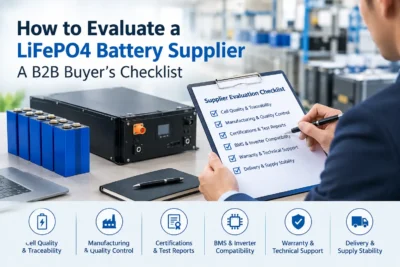
9. Evaluate the LiFePO4 Battery Supplier
Product quality is only one part of LiFePO4 battery supplier evaluation.
Before placing a bulk order, ask:
| Factor |
Questions to Ask |
| Cell Source |
Which manufacturer and model are used? |
| Quality Control |
How are cells and finished batteries inspected? |
| Testing |
What tests are performed before shipment? |
| BMS |
Which BMS is used? |
| Certifications |
Which documents are available? |
| Production |
What is the production capacity? |
| Lead Time |
How long is production? |
| Warranty |
What are the warranty terms? |
| After-Sales |
How are quality claims handled? |
| OEM/ODM |
Can the battery be customized? |
A supplier that can provide clear answers, technical documentation, testing information, and consistent communication is generally easier to evaluate than one that focuses only on price.
LiFePO4 Battery Quality Inspection Checklist
Before confirming a bulk order, buyers should check:
- ✓ Cell manufacturer and model
- ✓ Cell grade and batch information
- ✓ Actual capacity test
- ✓ Cycle-life test conditions
- ✓ BMS protection functions
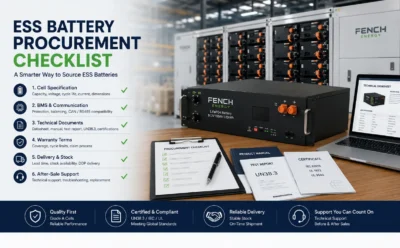
- ✓ Applicable certifications and test reports
- ✓ Manufacturing quality control
- ✓ Sample testing results
- ✓ Batch consistency
- ✓ Product traceability
- ✓ Warranty terms
- ✓ Production capacity and lead time
- ✓ After-sales support
- ✓ OEM/ODM capabilities if required
Final Thoughts
Knowing how to evaluate LiFePO4 battery quality before a bulk order can help buyers reduce procurement risks and avoid costly quality problems.
Instead of comparing price and specifications alone, evaluate the complete supply chain—from cell quality and capacity testing to BMS performance, certifications, manufacturing processes, sample testing, and batch consistency.
For distributors, solar installers, and energy storage companies, choosing a reliable supplier is essential for maintaining stable product performance and long-term customer satisfaction.
Fench Power provides LiFePO4 battery solutions for residential and commercial energy storage applications, with technical support, quality-control processes, and flexible OEM/ODM capabilities for global partners.