

BMS Communication Protocol: Battery-Inverter Compatibility Guide

When buying a battery for an energy storage system (ESS), voltage and capacity are not enough. You also need to confirm whether the BMS communication protocol is compatible with your inverter.
A battery can have the correct voltage and capacity but still fail to communicate with an inverter because of an incompatible BMS protocol, communication interface, cable, or configuration.
For ESS integrators, distributors, and installers, checking battery-inverter compatibility before ordering can help prevent communication faults and commissioning delays.
What Is a BMS Communication Protocol?
A BMS communication protocol defines how the battery management system (BMS) exchanges data with an inverter, EMS, or other equipment.
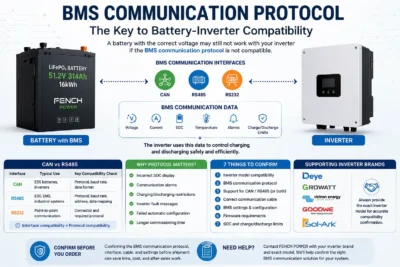
Common communication interfaces include:
Protocols may include Modbus or manufacturer-specific protocols.
Through BMS communication, the battery can send the inverter information such as:
- Battery voltage
- Charging and discharging current
- State of charge (SOC)
- Battery temperature
- Alarm and protection status
- Charge and discharge limits
The inverter uses this information to manage the battery safely.
CAN or RS485 compatibility alone does not guarantee communication. The BMS protocol and data format must also match the inverter.
Why Isn’t Voltage Compatibility Enough?
Two 51.2V LiFePO4 batteries can have the same electrical specifications but different BMS communication protocols.
If the inverter does not support the battery’s protocol, common problems include:
- Incorrect SOC display
- Communication alarms
- Charging or discharging restrictions
- Inverter fault messages
- Failed automatic configuration
Therefore, battery-inverter compatibility requires both electrical and communication compatibility.
CAN vs RS485 for Battery Communication
CAN and RS485 are both widely used in ESS battery systems. The correct option depends on the inverter’s supported interface and protocol.
| Interface | Typical Use | Key Compatibility Check |
|---|---|---|
| CAN | ESS batteries and inverters | Protocol, baud rate, data format |
| RS485 | ESS, EMS and industrial systems | Protocol, baud rate, address, data mapping |
| RS232 | Point-to-point communication | Connector and required protocol |
The key distinction is:
CAN and RS485 are communication interfaces, while the BMS communication protocol defines how the data is interpreted.
An inverter with a CAN or RS485 port may therefore still require a specific battery protocol.
Which Inverter Brands Can the Battery Support?
Common ESS inverter brands include Deye, Growatt, Victron Energy, GoodWe, and Sol-Ark.
However, brand compatibility alone is not enough. Different inverter models may require different BMS protocols, communication settings, cables, or firmware.
Always provide the supplier with the exact inverter model when checking battery compatibility.
What Should ESS Buyers Confirm?
Before ordering, confirm these key points with your battery supplier:
- Inverter model – Is the exact model supported?
- BMS protocol – Which communication protocol does the battery use?
- Interface – Does it support CAN, RS485, or both?
- Cable – Is the correct communication cable and pinout provided?
- Configuration – Are BMS settings, baud rate, or device address required?
- Firmware – Are specific BMS or inverter firmware versions required?
- SOC and limits – Can the inverter receive SOC and charge/discharge limits correctly?
These checks should be completed before shipment rather than during installation.
What Happens When the BMS Protocol Does Not Match?
A typical problem is a battery that powers on normally but is not recognized correctly by the inverter.
For example, a 51.2V LiFePO4 battery may have the correct voltage but still show a communication fault or incorrect SOC.
The installer should then check the:
- CAN or RS485 connection
- BMS communication protocol
- Communication cable and pinout
- Communication settings
- BMS and inverter firmware
This is why BMS communication protocol compatibility should be confirmed before shipment.
Final Thoughts
For ESS projects, BMS communication protocol is an important part of reliable battery-inverter integration.
Before ordering, provide your supplier with the inverter brand, exact model, communication interface, and protocol requirements.
Need to check battery inverter compatibility?
Send us your inverter brand and exact model. Fench Power can help confirm the required BMS communication protocol, interface, and configuration before ordering.
FAQ
Does every 51.2V battery work with every inverter?
No. Voltage compatibility is only one part of the process. The BMS protocol, interface, cable, and configuration must also be supported.
Is CAN better than RS485?
Not necessarily. Both are widely used. The correct choice depends on the inverter and supported BMS protocol.
Can one BMS support multiple protocols?
Yes. Some BMS platforms support multiple interfaces or configurable protocols, depending on the BMS design.
How do I check battery-inverter compatibility?
Provide the supplier with the inverter brand and exact model, then confirm the battery voltage, BMS protocol, interface, cable, settings, and firmware requirements.

LiFePO4 Battery Voltage Chart: Cell, 12V, 24V and 48V Systems Explained
Looking at a “48V” battery with a datasheet that says “51.2V”? You haven’t necessarily found a typo. This LiFePO4 battery
Home Battery Storage Without Solar: An Installer’s Guide to Sizing and Smart Tariffs
Home battery storage without solar allows households to charge a battery from the grid and use that electricity later. For
Home Battery Electricity Bill Savings in 2026: A Guide for European Solar Installers
Home battery electricity bill savings depend on electricity tariffs, solar generation, household consumption, and battery performance. In 2026, residential battery

EU Battery Passport 2027: What Home ESS Battery Suppliers Need to Prepare
The EU Battery Passport 2027 requirement starts on 18 February 2027. For home energy storage suppliers, two questions come first:

Net Metering in the Netherlands Ends in 2027: A Battery Guide for Installers
Net metering in the Netherlands ends on 1 January 2027. For solar installers and residential battery distributors, this gives homeowners
Adding a LiFePO4 Battery to an Existing Solar System: An Installer’s Checklist
Adding a LiFePO4 battery to an existing solar system can increase solar self-consumption, reduce evening grid imports and provide backup