Looking at a “48V” battery with a datasheet that says “51.2V”? You haven’t necessarily found a typo.
This LiFePO4 battery voltage chart explains how cell voltages add up—and what those numbers mean when choosing batteries for a project.
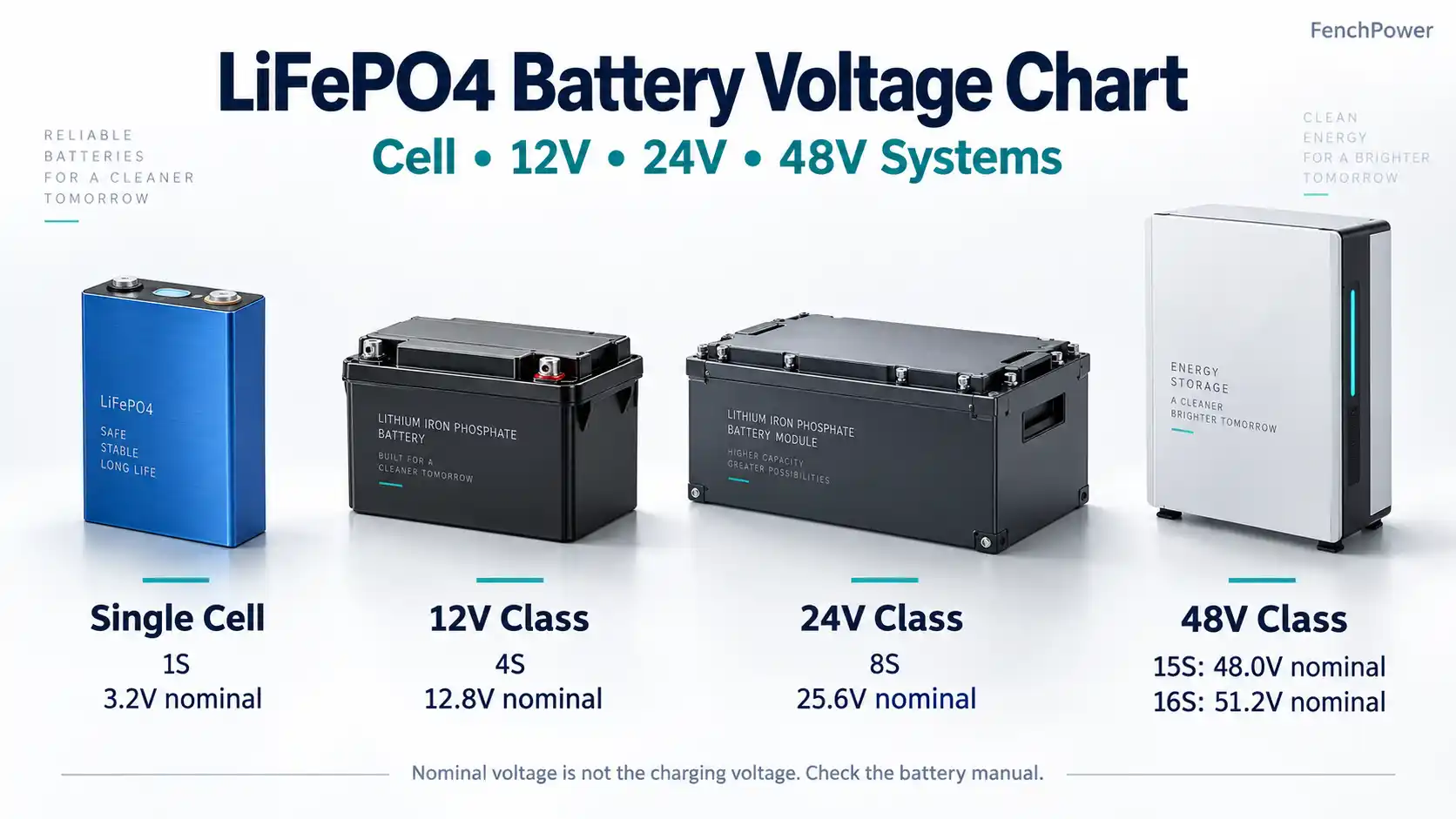
A typical LiFePO4 cell is rated at 3.2V nominal. Connect four, eight or sixteen cells in series, and you get 12.8V, 25.6V or 51.2V. The important detail: nominal voltage identifies the battery configuration. It is not your charger setting.
LiFePO4 Battery Voltage Chart
“S” means cells connected in series. Add their voltages together to get the pack voltage.
| Configuration |
Series cells |
Nominal voltage |
At 3.50V per cell* |
At 3.65V per cell* |
| Single cell |
1S |
3.2V |
3.50V |
3.65V |
| 12V-class battery |
4S |
12.8V |
14.0V |
14.6V |
| 24V-class battery |
8S |
25.6V |
28.0V |
29.2V |
| 48V-class battery |
15S |
48.0V |
52.5V |
54.75V |
| 48V-class battery |
16S |
51.2V |
56.0V |
58.4V |
The last two columns show calculated values. They are not universal charging settings, protection thresholds or state-of-charge measurements.
For a 16S pack, the calculation is straightforward: 16 × 3.2V = 51.2V. Choosing the right charging settings takes more than a calculator—check the battery manual too.
Why Does a 48V Battery Say 51.2V?
Because “48V” sometimes describes the system class rather than the exact nominal voltage.
A 15S LiFePO4 pack is nominally 48.0V; a 16S pack is 51.2V. Both may appear in searches for 48V batteries, but their charging requirements differ.
Before ordering, check the inverter’s supported battery voltage range. Matching the number on the box is only the beginning.
The same applies to communication. A CAN or RS485 port does not guarantee that the battery and inverter will understand each other. The protocol, firmware and cable pinout must also match. Our battery–inverter compatibility guide explains what to check before installation day.
Charging Voltage: What the Product Manual Actually Says
Let’s use a specific example: FenchPower’s 51.2V 5.12kWh wall-mounted battery.
Its published 51.2V 100Ah product manual, revision A0, lists these parameters on pages 7–8:
| Parameter |
What it means |
| 56.0V charge voltage |
The constant-voltage target after the specified constant-current stage. Charging ends when current falls to ≤0.05C. |
| 44.8V discharge cut-off |
The endpoint in the standard discharge procedure. The table does not identify it as a BMS protection threshold or everyday discharge target. |
| 50A maximum charge current |
The stated maximum. The table does not specify continuous-duty conditions or temperature/SOC derating. |
| Operating guidance |
Recommended SOC: 15–95%; standard charging temperature: 0–45°C. |
These figures come from published documentation, not independent testing. Confirm that the manual revision and BMS settings match the unit being supplied.
Other batteries may use different targets. For instance, Victron’s Lithium Battery Smart manual specifies 14.2V absorption for its 12.8V batteries. Charger settings are model-specific—not a copy-and-paste exercise.
A Procurement Checklist That Saves Follow-Up Emails
Before placing a distributor or project order, get these details confirmed:
| Check |
What to ask for |
| Battery configuration |
Exact model and series cell count |
| Voltage compatibility |
Inverter operating range and approved charging settings |
| Charge/discharge limits |
Recommended values, continuous-current ratings, derating and protection thresholds |
| Communication |
Supported inverter model, protocol, firmware and cable |
| Documentation |
Applicable datasheet, installation manual and compliance documents |
| Commercial terms |
MOQ, lead time, warranty and delivery terms for your destination |
Start with the FenchPower download centre. If a document is missing, request it for the exact model you intend to purchase.
Questions Buyers Often Ask
Can voltage tell me the exact state of charge?
Not reliably. LiFePO4 has a relatively flat discharge curve, and voltage changes with load, temperature and rest time. Use a properly configured BMS with SOC estimation or a suitable battery monitor. Victron’s battery monitor documentation covers the relevant settings.
Is 58.4V right for every 48V battery?
No. That number comes from 16 × 3.65V. Some 16S batteries specify lower charging targets, and you must not apply it automatically to a 15S pack.
What voltage means the battery is empty?
There is no single answer for every pack. Follow the model’s operating limits, and keep the recommended discharge endpoint separate from protective shutdown.
Get the Right Documents for Your Next Order
Send FenchPower your project or purchasing requirements, including:
- Company name and destination country.
- Inverter model and firmware, if known.
- Battery capacity and order quantity.
- Installation conditions and required delivery date.
Ask for the relevant specifications, installation instructions, written compatibility confirmation, available compliance documents and quotation terms. A few clear details now can save a much longer conversation during commissioning.