LiFePO4 battery certification is a key part of battery sourcing for solar energy storage, backup power, OEM equipment, and other international applications. For B2B buyers, the right documents help confirm whether a battery is suitable for transportation, import, installation, and sale in the target market.
UN38.3, IEC 62619, UL 1973, CE, and other documents do not serve the same purpose. A test report for one battery model may not cover another model or a complete energy storage system.
Before placing a bulk order, check the required standards for your application and verify the documents for the exact battery product.
Why LiFePO4 Battery Certification Matters
Certification and compliance documents can affect:
- International battery transportation
- Import and customs procedures
- Project approval
- Installation requirements
- Distributor qualification
- Market access
The requirements depend on the battery type, application, configuration, and destination market.
For this reason, do not rely on certification logos alone. Ask the supplier for the actual documents and check whether the model, capacity, voltage, and test scope match the product being purchased.
UN38.3: Lithium Battery Transportation
UN38.3 refers to the lithium battery transport tests in the UN Manual of Tests and Criteria, Part III, Sub-section 38.3.
The testing covers conditions that lithium batteries may experience during transportation, including:
- Altitude simulation
- Thermal testing
- Vibration
- Shock
- External short circuit
- Impact or crush
- Overcharge
- Forced discharge
UN38.3 is important when shipping LiFePO4 batteries internationally. Freight forwarders and carriers may request the relevant test documentation before accepting a shipment.
UN38.3 focuses on transport safety. It does not replace product safety standards for battery operation or complete energy storage systems.
IEC 62619: Industrial Lithium Battery Safety
IEC 62619 specifies safety requirements for secondary lithium cells and batteries used in industrial applications.
It is relevant to applications such as:
- Stationary energy storage
- Industrial backup power
- Telecom systems
- Renewable energy systems
- Industrial equipment
For B2B buyers, check what the IEC 62619 documentation actually covers. A report for a cell, battery pack, or complete system should not be treated as interchangeable.
When reviewing a report, compare the product model, rated voltage, capacity, configuration, test scope, and applicable standard edition with the battery you plan to purchase.
UL 1973: Stationary Battery Safety
UL 1973 covers safety requirements for batteries used in stationary applications, including energy storage and backup power systems.
It is particularly relevant to projects targeting the US and Canadian markets.
UL 1973 should not be confused with system-level standards. UL 9540 covers energy storage systems, while UL 9540A is a test method used to evaluate thermal runaway and fire propagation characteristics.
If a project requires UL compliance, confirm exactly which product and system-level standards apply before ordering.
LiFePO4 Battery Certification in Europe
European buyers should evaluate compliance according to the specific product and intended application. Depending on the battery and market, relevant requirements may include CE marking, the EU Battery Regulation, RoHS, SDS, UN38.3, and applicable IEC standards.
CE is a conformity marking for products covered by applicable EU legislation. It is not a single battery certification that automatically covers every requirement.
For energy storage projects, buyers should confirm the applicable EU rules before purchasing rather than relying on a generic “CE certified” statement from a supplier.
Certificate vs Test Report vs Declaration
These documents are often confused during battery sourcing.
A test report records the tests performed and their results.
A certificate confirms compliance or certification under a specific certification scheme.
A Declaration of Conformity (DoC) is the manufacturer’s formal declaration that a product meets applicable requirements.
They are not interchangeable.
If a supplier claims that a LiFePO4 battery is “IEC 62619 certified,” request the supporting document and check:
- Product model
- Manufacturer
- Rated voltage and capacity
- Test scope
- Testing organization
- Issue date
- Applicable standard and edition
How to Verify LiFePO4 Battery Certification
Before placing a bulk order, confirm:
- Does the document match the exact battery model?
- Does the voltage and capacity match the datasheet?
- Is it for the cell, battery pack, or complete system?
- Is the testing organization identifiable?
- Is the applicable standard clearly stated?
- Does it cover your target market and application?
- Are SDS and transportation documents available?
A reliable LiFePO4 battery supplier should provide consistent information across the datasheet, test reports, certification documents, and product specifications.
Final Takeaway
LiFePO4 battery certification should be evaluated together with battery specifications, testing data, quality control, and supplier capability.
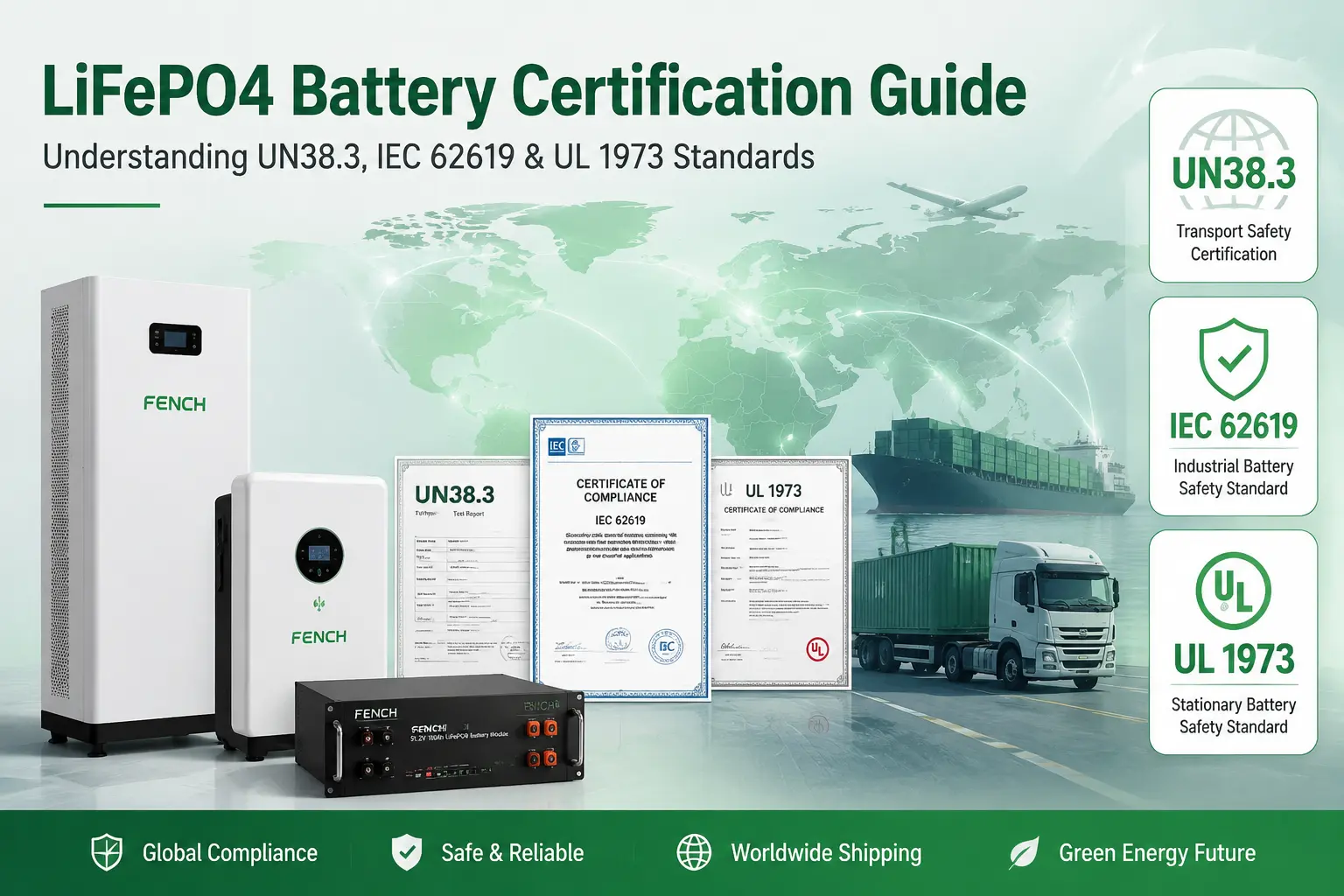
In simple terms, UN38.3 focuses on transportation, IEC 62619 addresses industrial lithium battery safety, and UL 1973 applies to stationary battery applications. European projects may also require CE marking, EU Battery Regulation compliance, and other applicable documentation.
Before placing a bulk order, verify the actual documents for the exact battery model. Certification logos alone are not enough.
Need LiFePO4 batteries for energy storage or OEM projects? Contact Fench Power to confirm product specifications, certification documents, and market-specific compliance requirements.