Learning how to charge a LiFePO4 battery starts with matching the charger’s voltage, current and charging programme to the exact battery model.
That sounds straightforward—until two batteries labelled “48V” arrive with different charging instructions. Both may be correct. The label tells you the system class; the manual tells you how to charge it.
For installers, distributors and storage system buyers, these five checks can prevent a lot of unnecessary troubleshooting.
1. Check the Voltage Before Choosing a Charger
A battery’s nominal voltage is its rated voltage, not the voltage you should set on the charger.
Here is a quick reference using documented charging examples:
| Battery class |
Typical configuration |
Nominal voltage |
Documented charging example* |
| 12V |
4S |
12.8V |
14.2V — Victron Lithium Smart |
| 24V |
8S |
25.6V |
28.4V — supported Victron configuration |
| 48V |
16S |
51.2V |
56.8V — supported Victron configuration |
| 48V |
16S |
51.2V |
56.0V — FenchPower 5.12kWh example |
These are product-specific examples, not universal settings. “S” means cells connected in series. Some 48V-class packs use 15S and require different settings.
The Victron values come from its Lithium Battery Smart charging instructions. Always use the instructions for your actual battery.
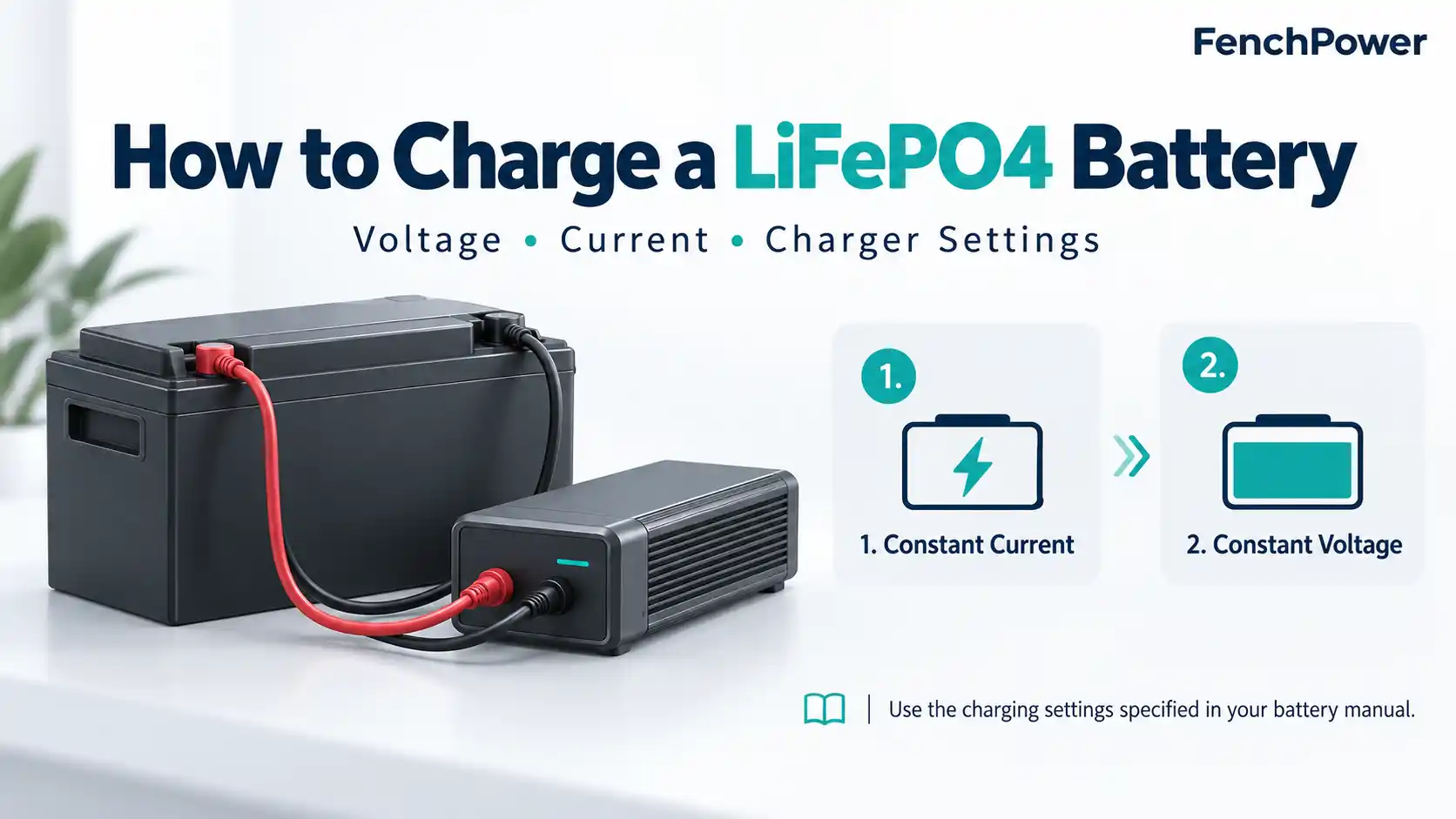
2. Understand How to Charge a LiFePO4 Battery in Two Stages
Most LiFePO4 charging follows two main stages:
- Constant current: the charger supplies a controlled current while voltage rises.
- Constant voltage: it holds the specified voltage while current gradually falls.
You may see this called CC/CV. The principle is simple; the finishing conditions vary by product.
For the FenchPower 51.2V 5.12kWh wall-mounted battery, the published 51.2V 100Ah manual, revision A0, pages 7–8, specifies:
| Parameter |
Published value |
| Standard charging current |
0.3C: 30A for this 100Ah battery |
| Constant-voltage target |
56.0V |
| End-of-charge current |
≤0.05C: 5A |
| Maximum charging current |
50A |
| Standard charging temperature |
0–45°C |
In plain English: charge at the specified current until 56V, then hold 56V until current falls to 5A or below.
These are published specifications, not independent test results. Confirm that revision A0 applies to the supplied unit. Its parameter table does not establish that 50A is suitable continuously under every temperature or charge condition.
3. Set a Sensible Charging Current
Charging current is often given as a “C-rate”. Multiply battery capacity in amp-hours by that number:
100Ah × 0.3C = 30A
A higher setting may shorten charging time, but the maximum rating is not automatically the recommended everyday setting.
Check the battery, BMS, charger, cables and protective devices. Follow the most restrictive applicable limit.
Also account for multiple charging sources. If solar and a grid-powered charger operate together, their combined battery charging current must remain within the permitted limit. Two chargers do not give one battery twice the allowance.
For more help comparing specifications, see our LiFePO4 battery datasheet guide.
4. Review the Whole Charging Programme
A charger’s “lithium” setting is a starting point, not a compatibility certificate.
Confirm:
- Charging voltage and current limit.
- Charging duration or current-based stopping condition.
- Whether float charging is required.
- Temperature protection.
- That lead-acid equalisation and desulfation modes are disabled.
Lead-acid equalisation is different from balancing cells inside a lithium battery.
For communicating home storage systems, confirm the inverter model, firmware, communication protocol and cable. Our BMS compatibility guide explains why matching connectors alone is not enough.
5. Watch the First Charge
Follow the manufacturer’s connection and startup sequence. During commissioning, monitor voltage, current, battery temperature and BMS messages.
If charging stops, read the alarm before increasing settings. Temperature restrictions, cell imbalance or communication faults may be responsible.
Do not bypass battery protection to keep charging. The alarm may be inconvenient, but it is telling you something useful.
Common Questions About LiFePO4 Charging
What voltage should I charge a 12V LiFePO4 battery to?
Use the voltage specified for that model. For example, Victron specifies 14.2V absorption for its 12.8V Lithium Smart batteries. Do not assume that value applies to every 12V LiFePO4 battery.
Should I leave a LiFePO4 battery on float charge?
Only with an approved charging programme. Some systems use a lower float voltage; Victron specifies 13.5V for the battery above. Float charging is not the same as holding the battery indefinitely at its absorption voltage.
Can I charge below freezing?
Only where the manufacturer expressly permits it under defined conditions. A battery’s discharge temperature range does not establish its charging temperature range.
Get Charging Compatibility Confirmed Before Ordering
Distributors and storage integrators can send FenchPower a project enquiry with the required capacity, inverter or charger model, purchase quantity, installation temperature range and destination country.
Request model-specific charging instructions, written compatibility confirmation and a quotation. A few details now can save several calls from the installation site.