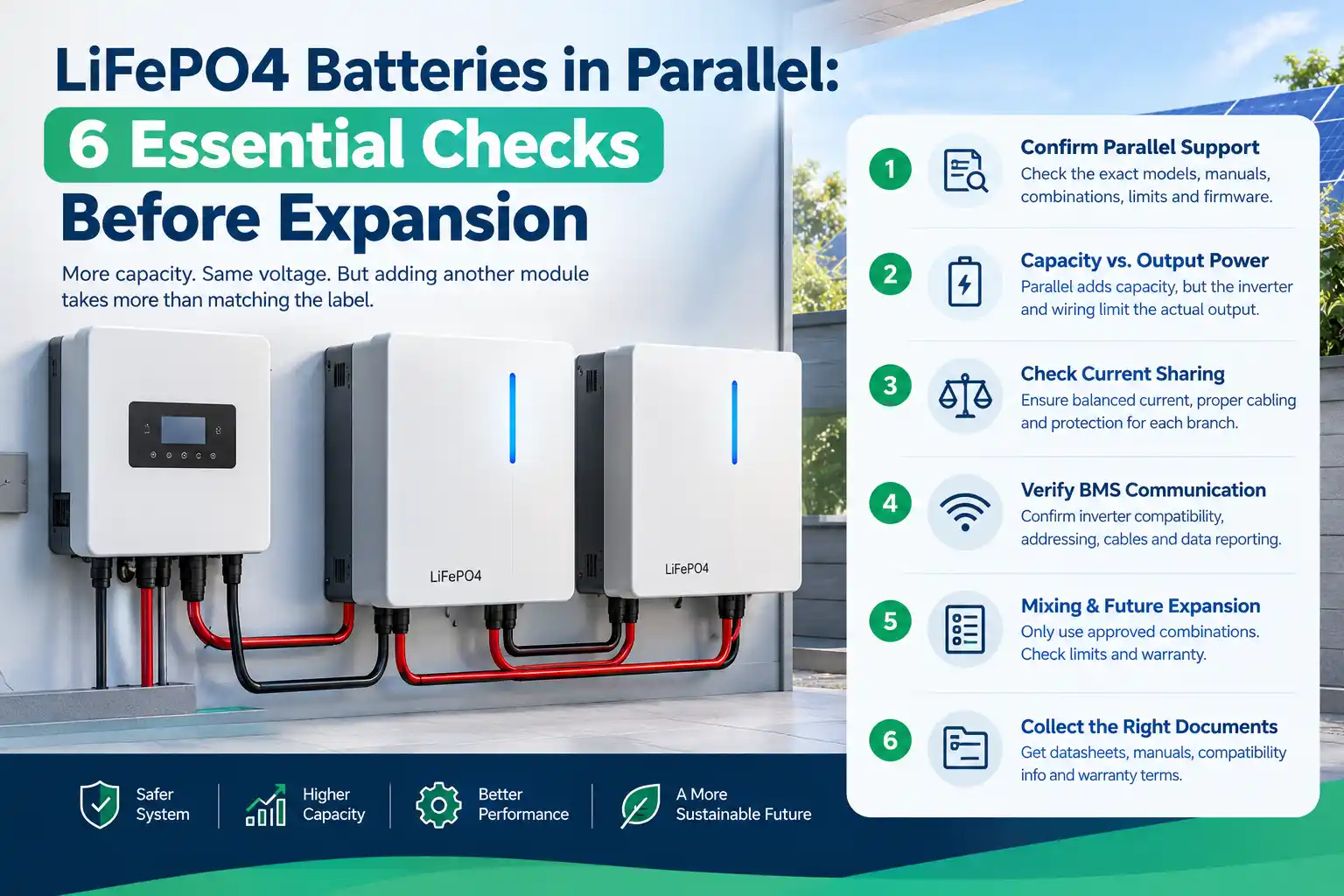
LiFePO4 batteries in parallel can increase storage capacity while keeping the bank’s nominal voltage unchanged. But adding another module takes more than finding a battery with the same voltage on its label.
For installers and distributors, the questions come quickly: Can we mix capacities? Will the inverter recognise every module? What happens if one battery disconnects?
Those questions are best answered before the quotation becomes an installation. Here are six checks to work through with the battery supplier.
1. Confirm That the Exact Batteries Support Parallel Operation
Start with the model numbers and current installation manuals.
“Supports parallel connection” should come with details: permitted module combinations, maximum battery count, firmware requirements and commissioning instructions.
A shared voltage label is not enough. Two products sold as “48V” may have different cell configurations or operating limits.
For example, Victron’s Lithium Battery Smart installation manual provides specific rules for battery-bank combinations and recommends matching capacity, age and model where possible. Those instructions apply to the batteries covered by that manual—not automatically to another manufacturer’s products.
Ask for written confirmation covering the actual combination you intend to supply.
2. Separate Extra Capacity From Extra Output Power
Parallel connection adds capacity, but the complete system determines how much power you can deliver.
Consider two hypothetical, compatible modules, each rated at 51.2V and 100Ah:
| Configuration |
Nominal voltage |
Combined capacity |
Calculated nominal energy |
| One module |
51.2V |
100Ah |
5.12kWh |
| Two approved parallel modules |
51.2V |
200Ah |
10.24kWh |
These figures illustrate the calculation. They do not confirm an approved FenchPower configuration or its usable energy.
The inverter still has its own power limit. Battery current ratings, temperature limits, wiring and protection also constrain output.
Likewise, two modules rated at 100A each should not be treated as a guaranteed 200A supply under every operating condition. Confirm the bank-level rating and how the system responds if one module becomes unavailable.
3. Check How the Batteries Share Current
Parallel batteries do not necessarily carry identical current.
Differences in battery condition and connection resistance can cause one branch to work harder than another. That can become noticeable when charging quickly or supplying a large load.
The installation design should address balanced current paths, appropriate conductor sizes, connection quality and protection for each branch. Follow the equipment manufacturer’s approved arrangement rather than copying a convenient-looking wiring diagram.
Commissioning should include checking individual module currents under representative loads. A bank that reports the expected total capacity may still have uneven current sharing.
For procurement, ask a practical question: What measurements should the installer record to confirm that the bank is operating correctly?
4. Confirm BMS Communication With the Inverter
Electrical compatibility and communication compatibility are separate checks.
Some systems use a designated master battery to communicate combined bank information to the inverter. Others use a different control arrangement. Confirm how the selected equipment works.
Check:
- Supported inverter model and firmware.
- Battery addressing and communication settings.
- Required cables and termination.
- How combined state of charge is reported.
- How charging and discharging limits change when a module disconnects.
A CAN or RS485 socket tells you the interface, not whether the devices understand one another.
Our BMS communication protocol guide explains the questions to resolve before choosing equipment.
5. Ask About Mixing Capacities and Expanding Later
Can you connect LiFePO4 batteries of different capacities in parallel?
Only use combinations explicitly supported by the manufacturers and system design. Some product families permit mixed capacities; others require matching modules. There is no universal approval based on chemistry alone.
The same applies when adding a new battery to an older installation. Age, condition, firmware and operating limits can affect the result.
Before offering future expansion to a customer, confirm:
| Question |
Evidence to request |
| Which modules can be added? |
Approved model combinations |
| How many are supported? |
Maximum bank size and conditions |
| Can older and newer versions mix? |
Hardware and firmware guidance |
| How are modules prepared? |
Manufacturer’s commissioning procedure |
| Does expansion affect warranty? |
Applicable written warranty terms |
“Expandable” is useful only when the expansion conditions are clear.
6. Request the Documents Before Placing the Order
For a distributor order or installation project, collect the documents while comparing suppliers.
Ask for the exact model’s datasheet, installation manual, parallel-operation instructions, inverter compatibility information and warranty terms. Request applicable compliance documents for the destination market as well.
Use the FenchPower download centre as a starting point, then request anything missing for your proposed configuration.
Keep the approved model list and firmware details with the project record. They make later servicing and expansion much easier.
Planning a Parallel Battery Bank?
Send FenchPower your project requirements, starting with the inverter model, required storage capacity and intended number of modules.
For an expansion, include the existing battery model, age and firmware if available. Request written confirmation of the supported arrangement, relevant documentation and quotation before ordering.
The capacity calculation is straightforward. Confirming that the batteries, controls and inverter work together is what makes the project ready to install.