
Adding a LiFePO4 Battery to an Existing Solar System: An Installer’s Checklist

Adding a LiFePO4 battery to an existing solar system can increase solar self-consumption, reduce evening grid imports and provide backup power when the system is designed for it. However, a battery retrofit involves more than connecting a battery to the existing solar inverter.
For installers, distributors and residential energy storage buyers, the right solution depends on the existing inverter, electrical layout and customer loads.
Can You Add a LiFePO4 Battery to an Existing Solar System?
In many cases, yes. The retrofit usually follows one of three approaches:
- Retain the existing grid-tied inverter and add a compatible AC-coupled battery inverter.
- Connect the battery to an existing hybrid inverter that supports the proposed battery.
- Replace an unsuitable or ageing inverter with a compatible hybrid inverter and battery system.
A standard solar inverter’s PV input is not a battery connection. The system needs equipment designed to control battery charging, discharging and protection, plus backup operation where required.
Before preparing a quotation, confirm whether the customer wants higher solar self-consumption, backup power, peak-load support or a combination of these objectives.
1. Check the Existing Solar Inverter
Record the exact inverter model, rated output and firmware version, and obtain its installation manual. Also confirm whether the property has a single-phase or three-phase supply.
Collect:
- Inverter brand, exact model and firmware
- PV array capacity and string arrangement
- Single-phase or three-phase electrical supply
- Existing export limitation or smart-meter arrangement
- Available installation space and cable routes
- Essential circuits and expected backup duration
Products from the same manufacturer are not automatically compatible. The exact inverter model, firmware and battery configuration still need to be checked.
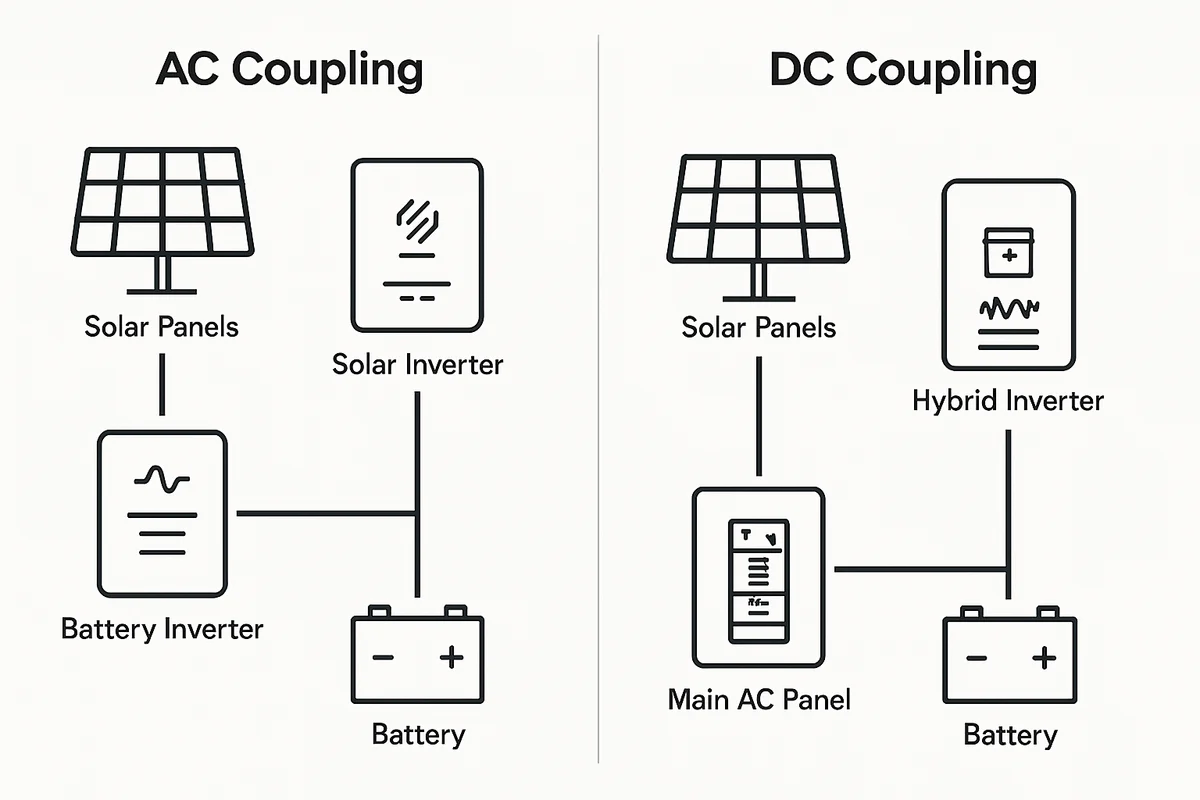
2. Compare AC-Coupled and DC-Coupled Battery Retrofits
AC-Coupled Battery Retrofit
An AC-coupled retrofit can retain the existing solar inverter and add a separate battery inverter/charger or integrated AC battery system.
This approach is worth assessing when the existing solar equipment is working well. However, AC coupling does not automatically provide backup during a grid outage. Backup operation requires a suitable inverter, changeover arrangement and control strategy supported by the equipment manufacturers.
DC-Coupled Battery Retrofit
With a compatible hybrid inverter, solar generation and battery storage connect on the DC side. This may suit an installation that already has a supported hybrid inverter, or a project where the old inverter is due for replacement.
Replacing the inverter may involve additional wiring, configuration and compliance checks. Compare the complete installed cost, including equipment, labour and commissioning.
3. Confirm LiFePO4 Battery and BMS Compatibility
Electrical compatibility and communication compatibility must both be confirmed before ordering.
Battery Voltage and Power Limits
Check:
- Permitted battery voltage range
- Usable energy capacity
- Continuous charge and discharge current
- Peak power and short-duration limits
- Parallel connection and battery expansion limits
A 51.2V LiFePO4 battery is not automatically suitable for every inverter marketed as a 48V system. The battery’s operating voltage range and current limits must meet the inverter’s requirements.
BMS Communication and Firmware
Confirm:
- Supported BMS communication protocol
- CAN, RS485 or other required interface
- Communication cable and pinout
- Required inverter and BMS settings
- Supported firmware versions
Having a CAN or RS485 port does not prove that two products can communicate. The protocol, data format, cable and configuration must also match.
Provide the supplier with the exact inverter model and firmware version. For more detail, see Fench Power’s BMS communication protocol guide.
4. Calculate Battery Capacity and Output Power
Battery capacity is measured in kilowatt-hours (kWh), while output power is measured in kilowatts (kW). Capacity affects how long the system can supply energy; output power determines which loads can operate at the same time.
Estimate the Required Battery Capacity
Use overnight consumption, available solar surplus, essential backup loads and the required runtime.
For example, if a customer needs 8kWh of AC energy overnight, and the design assumes a 90% usable battery window and 92% discharge-path efficiency:
Required nominal capacity ≈ 8 ÷ (0.90 × 0.92) = 9.7kWh
This is an illustrative calculation, not a guaranteed performance figure. Adjust the design for backup reserve, battery ageing, seasonal variation and future load growth.
Check Continuous Power and Starting Loads
Battery capacity will not solve an inverter power limitation. Check both the battery’s discharge capability and the inverter’s continuous and surge ratings.
Assess heating equipment, pumps, compressors and other starting loads separately.
5. Define the Solar Battery Backup Requirements
Battery storage does not automatically mean whole-home backup. Before issuing a quotation, agree which circuits must remain powered and confirm:
- Selected-load or whole-home backup
- Expected backup duration
- Maximum backup output
- Transfer-time requirements
- Whether solar charging can continue during an outage
- Which loads are excluded
In an AC-coupled backup system, the battery inverter and PV inverter must work together as loads change and the battery approaches full charge. Follow the manufacturers’ supported wiring diagrams and commissioning procedures.
6. Complete the Solar Battery Retrofit Checklist
| Area | Information to Confirm |
|---|---|
| Existing system | Inverter model, firmware, PV capacity and phase arrangement |
| Customer objective | Self-consumption, backup, peak-load support or combined use |
| Battery selection | Voltage, usable energy, current limits and expansion options |
| BMS communication | Protocol, interface, cable, settings and firmware |
| Installation location | Space, temperature, clearances and cable routes |
| Electrical design | Protection, metering, backup circuits and changeover arrangement |
| Documentation | Datasheets, manuals, compliance documents and warranty terms |
| Commissioning | Charge settings, communication tests, metering and backup tests |
Keep the approved inverter–battery configuration and commissioning records for repeat projects. Recheck compatibility whenever the battery model, BMS or inverter firmware changes.
Frequently Asked Questions
Can I Add a LiFePO4 Battery Without Replacing My Solar Inverter?
In many cases, an AC-coupled retrofit can retain the existing solar inverter and add a separate battery inverter/charger. The proposed equipment and system layout still need to be assessed for compatibility.
Will Adding a Battery Provide Backup During a Power Cut?
Only if the system has a supported backup design, suitable changeover equipment and correctly configured backup circuits. A battery installed solely for solar self-consumption may not provide power during an outage.
What Information Does a Battery Supplier Need for a Retrofit?
Provide the exact inverter model, firmware version, installation country, target battery capacity and backup requirements. Include the property’s phase arrangement and planned expansion where relevant.
Plan Your LiFePO4 Battery Retrofit with Fench Power
Fench Power supplies LiFePO4 battery cells, residential storage batteries, BMS products and related components for installers, distributors and residential energy storage businesses.
Send us the inverter model, installation country, target capacity, backup requirements and delivery location. Our team can review the proposed battery configuration before you order.
Contact Fench Power about your project.
Final system design and installation must follow the manufacturers’ instructions and applicable local electrical requirements, with assessment by a qualified installer.
Home Battery Electricity Bill Savings in 2026: A Guide for European Solar Installers
Home battery electricity bill savings depend on electricity tariffs, solar generation, household consumption, and battery performance. In 2026, residential battery

EU Battery Passport 2027: What Home ESS Battery Suppliers Need to Prepare
The EU Battery Passport 2027 requirement starts on 18 February 2027. For home energy storage suppliers, two questions come first:

Net Metering in the Netherlands Ends in 2027: A Battery Guide for Installers
Net metering in the Netherlands ends on 1 January 2027. For solar installers and residential battery distributors, this gives homeowners
Adding a LiFePO4 Battery to an Existing Solar System: An Installer’s Checklist
Adding a LiFePO4 battery to an existing solar system can increase solar self-consumption, reduce evening grid imports and provide backup
How to Evaluate a LiFePO4 Battery Supplier: A B2B Buyer’s Checklist
How to evaluate a LiFePO4 battery supplier is an important question for distributors, installers, and ESS buyers. Price matters, but
BMS Communication Protocol: Battery-Inverter Compatibility Guide
When buying a battery for an energy storage system (ESS), voltage and capacity are not enough. You also need to